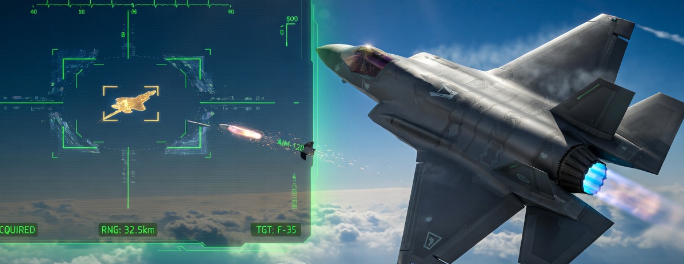
The Islamic Revolutionary Guard Corps (IRGC) has announced a significant escalation in regional hostilities, claiming to have successfully targeted a U.S. F-35 stealth fighter over central Iran. The strike, which allegedly occurred at 2:50 a.m. local time on March 20, 2026, marks the first time Tehran has officially reported the interception of the advanced fifth-generation jet. According to IRGC officials, the aircraft sustained heavy damage,
forcing an emergency landing at a nearby U.S. military base. While the final status of the jet is still being investigated, Iranian military sources expressed high confidence that the fighter was effectively neutralized, representing a potential turning point in the ongoing aerial conflict. Beyond the manned aircraft engagement, the IRGC reported the successful interception of 125 long-range drones deployed by the United States and Israel. The weapon utilized in the strike against the F-35 is identified as the SA-67, commonly referred to as Missile 358. This Iranian-made surface-to-air missile is a unique hybrid system capable of loitering in the air for extended durations. Its design allows it to track, identify, and engage high-value assets with high precision. By integrating long-range endurance with sophisticated anti-aircraft technology, the SA-67 poses a substantial threat to both unmanned systems and highly advanced stealth aircraft traditionally thought to be invisible to radar. Although independent confirmation of the F-35‘s damage has not yet been provided by the U.S. Department of Defense, the bold nature of the claim reflects Tehran’s growing strategic confidence. If verified, the strike would constitute a rare and high-profile loss of American stealth technology in active combat. This incident underscores the increasing dangers of operating in contested airspace over the Middle East, where domestic Iranian air defense systems are proving more capable than previously anticipated. As the broader conflict continues to involve multiple regional actors, the reported success of the Missile 358 highlights the evolving nature of modern warfare, where high-tech stealth assets face increasingly persistent and sophisticated ground-based threats.