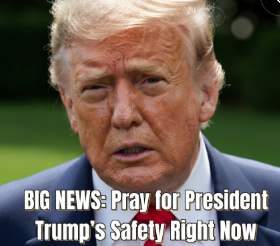
When a former member of the United States Secret Service publicly raises concerns about the safety of a former president, the warning tends to attract serious attention within security and policy circles. Recent comments by Dan Bongino have highlighted what he describes as an increasingly complex security environment surrounding Donald Trump.
Bongino, who served more than a decade in the Secret Service and worked on protective details across multiple administrations, emphasized that his observations are rooted in professional experience rather than political commentary. According to his assessment, modern threat environments often develop through the convergence of multiple pressures rather than a single identifiable source. He outlined four broad categories of potential risk: foreign adversaries with strategic motivations, domestic extremists influenced by political rhetoric, institutional tensions within segments of government, and the possibility that political optics could influence security decision-making. While each factor independently may warrant heightened awareness, Bongino argues that their combination creates an unusually complicated protective landscape for a former president. Foreign threats remain a central concern. Tensions involving Iran have persisted since the 2020 U.S. drone strike that killed Qassem Soleimani. Security analysts have long noted that such geopolitical events can produce long-term motivations for retaliation. Even within highly controlled security environments, determined actors or proxy networks may attempt to exploit potential vulnerabilities. Another international factor frequently discussed by intelligence professionals is the strategic posture of China. Analysts often note that countries closely monitor influential former leaders whose policies could shape future global dynamics, particularly when those individuals remain politically active. Domestic risks also form a significant part of modern threat assessments. Experts studying radicalization warn that prolonged exposure to inflammatory rhetoric or symbolic hostility can sometimes motivate isolated individuals to carry out acts of violence. While such incidents are rare, protective agencies treat them as serious possibilities because lone actors can be difficult to detect in advance. Historically, the United States has faced tragic examples of attacks on national leaders, including the assassinations of Abraham Lincoln, James A. Garfield, and John F. Kennedy. Security professionals frequently reference these events as reminders of the importance of early threat detection and proactive protective measures. Bongino ultimately stresses the importance of maintaining a strictly nonpartisan approach to security. The mission of the United States Secret Service is to evaluate threats through objective intelligence analysis and ensure that protective resources are deployed according to risk, not political considerations. In his view, safeguarding high-profile leaders—current or former—serves a broader institutional purpose. Effective protection reinforces public confidence in national institutions and demonstrates that the safety of public officials remains a matter of professional duty rather than political debate.