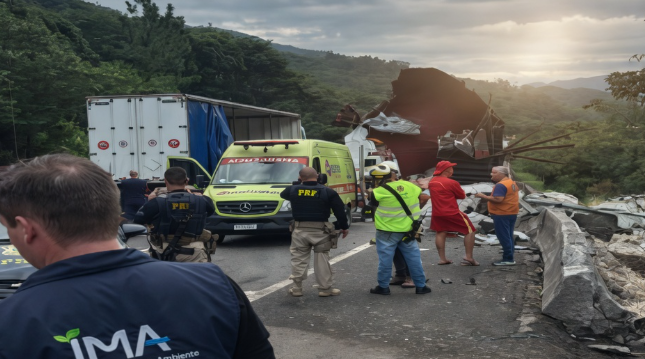
Tragedy on BR-251: Analyzing the Grão Mogol Collision and Brazil’s Highway Safety Crisis
On a Tuesday night that began with the mundane rhythm of long-haul travel, the community of Grão Mogol in northern Minas Gerais became the epicenter of a national tragedy. A devastating head-on collision between a cargo truck and a passenger van on the BR-251 highway resulted in the deaths of nine individuals and left twelve others fighting for their lives. The incident has transcended local news, sparking a profound national discourse on labor conditions, infrastructure neglect, and the heavy price of transit negligence in Brazil.
According to the Civil Police of Minas Gerais (PCMG), the technical cause of the accident appears to be a lane violation. Forensic expert Hugo Leonardo detailed that evidence at the scene—including specific skid marks and asphalt grooves—points toward the truck invading the opposite lane at high speed. This maneuver left the van, which was transporting workers back to their home state of Ceará, with no path for evasion. The force of the impact was so severe that emergency responders described the site as a “war zone,” with specialized teams from several municipalities required to extricate victims from the mangled wreckage of the van.
The human toll of the crash is particularly poignant, as the victims were largely laborers returning home after long stints at distant construction sites. Among those who perished was a prominent regional singer, a cultural figure whose music resonated with the working class. His death has served as a catalyst for collective mourning, as fans across Brazil gathered to leave tributes at his recording studio. The irony of the singer’s final social media post—expressing his joy at “finally heading home”—has added a layer of heartbreak to an already grim situation, with his lyrics about the road and home now serving as an anthem for the families left behind.
From a medical perspective, the survivors face an arduous path. Dr. Luana Reis, head of emergency care at the Grão Mogol Regional Hospital, emphasized that while twelve passengers survived, many remain in serious condition with complex fractures and head trauma. The psychological impact on families—many of whom traveled hundreds of kilometers from Ceará to Minas Gerais upon hearing the news—highlights the systemic vulnerability of migrant workers who rely on long-distance road transport to sustain their livelihoods.
The investigation into the truck driver’s conduct has raised significant questions regarding labor enforcement. The recovery of the truck’s tachograph suggests the driver may have exceeded the 12-hour consecutive driving limit mandated by federal law. Transportation safety analyst Paulo Mendes has been vocal in his critique, suggesting that the tragedy was not a mere accident but a symptom of a system that “turns a blind eye to exhaustion.” This sentiment was echoed by community leader Marisa Azevedo, who categorized these recurring incidents on the BR-251 as preventable failures rather than random acts of fate.
The BR-251 corridor itself has long been criticized for its hazardous conditions. Known for its narrow lanes, poor lighting, and high volume of heavy vehicle traffic, the highway is a notorious bottleneck for safety. In response to the public outcry following this latest catastrophe, the Ministry of Infrastructure announced an immediate review of the corridor’s safety protocols. Planned measures include the installation of new warning signage, increased patrol frequency, and the long-overdue construction of rest areas to mitigate driver fatigue. However, local skepticism remains high, as many feel these promises are reactionary and unlikely to address the deep-seated maintenance issues of the regional road network.
As Grão Mogol and the victims’ families begin the long process of burial and mourning, the event has forced a broader reckoning. The intersection of a beloved artist’s death and the loss of essential workers has unified diverse segments of Brazilian society in a demand for accountability. While the songs of the fallen singer continue to play on the radio as a tribute, the real legacy of this tragedy will be determined by whether the Ministry of Infrastructure and law enforcement agencies follow through on systemic reforms to ensure that the BR-251—and highways like it—cease to be sites of preventable slaughter.