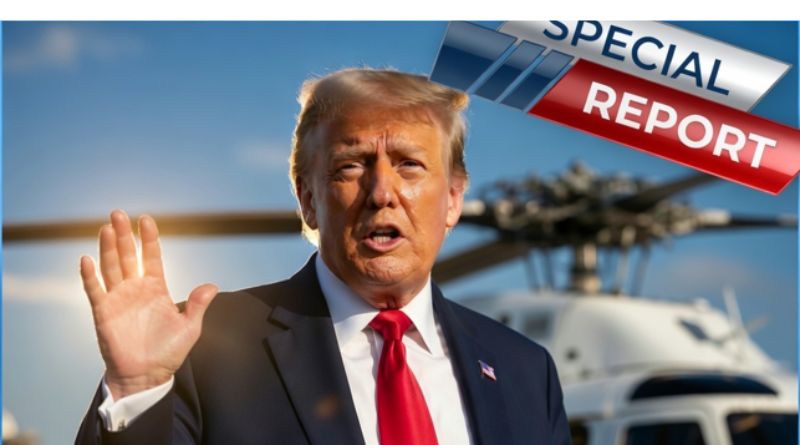
President Donald Trump warned that the United States would respond with decisive force if Iran carries out additional attacks on Qatar, suggesting that a potential U.S. response could include targeting the South Pars gas field—one of the most strategically important energy sites in the world.
Trump issued the warning on social media after Iranian missiles struck locations in Qatar, a development that has significantly escalated tensions across the Middle East and raised fresh concerns about the stability of global energy markets. The South Pars gas field, which is jointly shared by Iran and Qatar, is the largest natural gas reserve on Earth and a cornerstone of energy production for both countries.
The situation unfolds as the conflict between Iran and Israeli forces, backed by the United States, continues to intensify. A source familiar with recent developments said that while the United States was aware of an Israeli strike targeting infrastructure linked to the South Pars field, it did not directly participate in the operation.
Qatari officials confirmed that a ballistic missile struck a key natural gas facility, causing extensive damage to critical infrastructure. In the aftermath, Qatar moved to expel several Iranian embassy staff members, signaling a sharp deterioration in diplomatic relations between Doha and Tehran.
The growing conflict has already begun to affect global energy prices. Oil has risen by roughly 5 percent, surpassing $108 per barrel, as investors react to fears of supply disruptions. Analysts warn that continued instability in the Persian Gulf—particularly involving vital infrastructure and shipping lanes—could place significant strain on the global economy.
Since the conflict began on February 28, Iran has reportedly targeted energy infrastructure across the Gulf region and disrupted maritime traffic through the Strait of Hormuz. This narrow passage is one of the most critical chokepoints for global oil shipments, and any sustained interference there could have widespread economic repercussions.
The human toll of the conflict continues to mount. Reports indicate that at least 1,300 people have been killed in Iran, more than 960 in Lebanon, and 14 in Israel. The U.S. military has confirmed 13 service member deaths and approximately 200 injuries, highlighting the expanding scope and severity of the violence.
Israeli authorities have warned that further Iranian missile attacks could be imminent, while Bahrain has issued alerts urging its citizens to remain vigilant. Trump emphasized that Qatar had no involvement in Israeli military actions against Iran, calling Tehran’s strike on Qatari territory unjustified and dangerous.
Global leaders have also responded to the escalation. Australian Prime Minister Anthony Albanese condemned Iran’s missile strikes, particularly those targeting civilian infrastructure, and called for restraint. Across the Gulf, regional governments have echoed similar concerns, urging an immediate de-escalation of hostilities.
QatarEnergy reported that firefighting operations remain underway at damaged liquefied natural gas facilities. Although no casualties have been reported at those sites, the full extent of the damage is still being evaluated, and repairs may take time.
A recent summit of Gulf Arab nations concluded with a joint statement condemning Iran’s use of ballistic missiles and drones against civilian targets. The participating countries called for an immediate halt to attacks and stressed the importance of diplomatic efforts to prevent further escalation.
Security analysts warn that the strike on the South Pars field represents a major turning point in the conflict. The Soufan Center, a New York-based think tank, described the incident as a serious escalation that could carry long-term consequences for regional stability and global energy markets.
Additional incidents underscore the widening scope of the crisis. British officials reported that a vessel off the coast of the United Arab Emirates was attacked, resulting in a fire onboard. At the same time, a U.S. Senate measure related to the Iran conflict failed to advance, reflecting ongoing divisions in Washington over how best to respond.
Regional leaders have voiced increasing distrust toward Iran. Saudi Arabia’s foreign minister said confidence in Tehran has been “shattered,” while the United Arab Emirates condemned the strikes as a dangerous escalation and temporarily shut down parts of its gas operations as a precautionary measure.
Former National Counterterrorism Center Director Joe Kent suggested that internal disagreements over U.S. policy toward Iran may not have been fully communicated to Trump, raising questions about coordination within the administration during a critical moment.
Amid rising global tensions, security measures have also been heightened within the United States. In Palm Beach, Florida—where Trump maintains his Mar-a-Lago residence—local authorities have increased their security posture. South Ocean Boulevard has been closed to through traffic, with officials citing public safety concerns.
The Palm Beach County Sheriff’s Office said the enhanced measures are being coordinated with the U.S. Secret Service and will remain in place as long as necessary. Law enforcement presence has also been increased at several locations, including community and religious centers.
Former Secret Service agent Tim Miller said such precautions are typical during periods of heightened international tension, noting that security is often expanded at locations associated with high-profile figures. Officials emphasized that the measures are preventive, aimed at ensuring public safety amid concerns that the conflict could have broader implications beyond the Middle East.