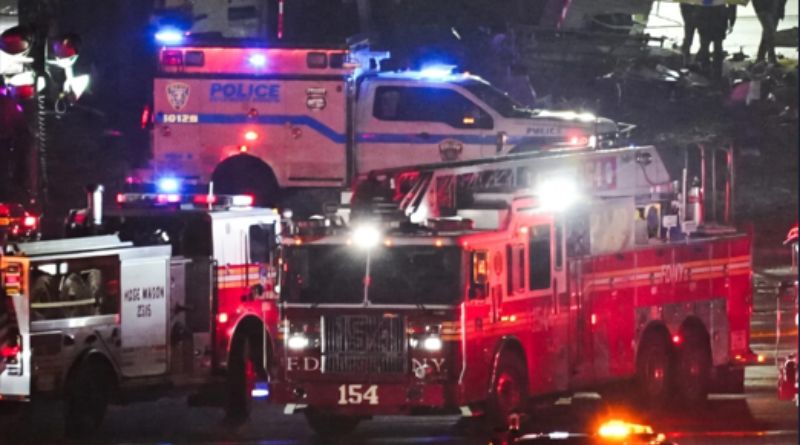
A tragic collision at New York’s LaGuardia Airport has intensified scrutiny of air traffic control procedures after a fire truck struck a landing Air Canada flight, killing two pilots and injuring dozens, according to early reports and expert commentary.
The crash unfolded Sunday night as emergency responders were dealing with a separate incident involving United Flight 2384, where crew members had reported a “weird odor” inside the cabin. A Port Authority fire vehicle was dispatched to assist. In a critical moment, however, the truck was cleared to cross an active runway just as Air Canada Flight 8646 was arriving.
Within seconds, the landing aircraft and the emergency vehicle occupied the same stretch of runway. The jet collided with the truck shortly after touchdown, producing a loud bang that passengers later described as shocking and disorienting. The plane continued to skid along the runway as panic spread through the cabin, with travelers struggling to understand what had just occurred.
Aviation expert and flight instructor David Evans told The U.S. Sun that the decision to allow the vehicle to cross mid-runway may have increased the risk of such a حادث. He explained that, in his view as a pilot, it is generally safer for ground vehicles to cross at the ends of runways, even if doing so takes more time.
“Personally, I prefer that vehicles cross at the runway ends,” Evans said. “It may delay the response slightly, but it reduces the chances of a direct conflict with an aircraft that is landing or taking off.”
Evans acknowledged that airport procedures can differ and that some professionals might disagree with his assessment. Still, he emphasized that the incident will likely prompt a broader review of operational protocols, especially those governing how emergency vehicles move across active runways during time-sensitive situations.
The two pilots who lost their lives have been identified as Antoine Forest of Québec and Mackenzie Gunther. Evans praised their actions, suggesting they likely relied on instinct and training in their final moments.
“As pilots, your emergency training becomes second nature,” he said. “If there had been a chance to perform a go-around, they would have taken it. They did everything they could.”
The National Transportation Safety Board (NTSB) has launched an investigation into the sequence of events that led to the crash, focusing in part on how clearance was given for the fire truck to enter the runway while the aircraft was landing. Early indications suggest that visibility conditions may also have been a contributing factor, potentially limiting the pilots’ ability to see the obstruction in time.
Audio from the control tower reveals the urgency and confusion in the moments surrounding the collision. A controller can be heard instructing another aircraft to hold position before urgently calling for the fire truck to stop.
“Stop, stop, stop… truck one,” the controller shouted over the radio. Shortly afterward, the same voice admitted, “I messed up,” underscoring the intense pressure faced by controllers managing multiple operations simultaneously.
Despite the apparent error, Evans urged caution in assigning blame, noting that air traffic controllers typically perform at a very high level under demanding conditions. He suggested that accidents like this often result from a combination of factors rather than a single failure.
Transportation Secretary Sean Duffy also addressed the situation, dismissing claims that understaffing in the control tower played a role. However, he joined aviation officials in calling for renewed investment in modernizing air traffic control systems.
Evans, who has experience in public office, expressed some skepticism about funding being the primary issue. “There’s always a call for more money after an incident,” he said. “But it’s not clear that funding alone would have prevented this.”
As investigators work to reconstruct the timeline, early reports indicate that events unfolded rapidly, leaving little time for corrective action once the conflict became apparent. The tragedy is expected to lead to both regulatory reviews and legal scrutiny as officials seek to understand how such a catastrophic breakdown occurred.