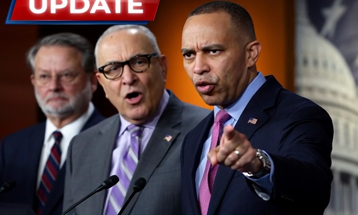
House Minority Leader Hakeem Jeffries warned Friday that failing to pass Democratic-backed immigration enforcement reforms could disrupt funding across parts of the Department of Homeland Security (DHS). Speaking on NPR’s Morning Edition, Jeffries said Republicans would bear responsibility for any shutdown affecting agencies beyond immigration enforcement if they decline to support the proposed reforms. His comments come as lawmakers face an approaching deadline to extend DHS funding.
Jeffries argued that federal spending priorities should reflect policies that improve affordability for Americans while ensuring immigration enforcement is conducted in a humane and accountable manner.
“Democrats have certainly articulated a position on behalf of the American people that taxpayer dollars should be used to make life more affordable for everyday Americans, not brutalize or kill them,” Jeffries said during the interview.
He also criticized the current operations of U.S. Immigration and Customs Enforcement (ICE), calling for substantial reforms within DHS.
“ICE is completely and totally out of control, and it needs to be reined in, which is why we need dramatic reform at the Department of Homeland Security,” Jeffries said.
Jeffries warned that if reforms are not approved, other DHS agencies—including the United States Coast Guard, Federal Emergency Management Agency (FEMA), and the Transportation Security Administration (TSA)—could be affected by a potential funding lapse.
NPR co-host Steve Inskeep noted during the interview that immigration enforcement agencies already have funding in place, suggesting that any shutdown would likely impact other DHS components rather than immigration operations.
With just over a week remaining before the DHS funding deadline, Jeffries and Senate Minority Leader Chuck Schumer unveiled a list of 10 demands that Democrats say must be addressed to maintain funding beyond Feb. 13.
The proposal calls for sweeping changes to federal immigration enforcement, including requiring judicial warrants before agents enter private property, mandating visible identification for officers, limiting enforcement near sensitive locations such as schools and medical facilities, and requiring body-worn cameras for DHS personnel.
Democratic leaders framed the plan as necessary reforms following the fatal shootings of two U.S. citizens during immigration operations in Minneapolis.
Republicans, however, strongly criticized the proposal. Senate Majority Leader John Thune described the demands as an “ultimatum,” accusing Democrats of refusing to negotiate in good faith.
The dispute sets the stage for a contentious budget battle with President Donald Trump and Republican leadership as the funding deadline approaches.