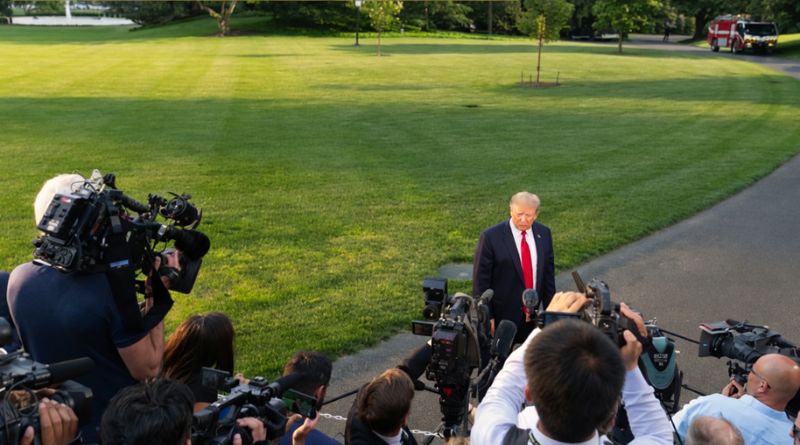
President Donald Trump has taken a firm stance in the ongoing political standoff over funding for the Department of Homeland Security (DHS), making clear that he is unwilling to compromise unless Democrats agree to support the SAVE America Act. In a late Sunday post on Truth Social, Trump urged Republicans to remain unified and resist any funding agreement that does not include the election-related provisions he considers essential.
Trump’s message emphasized that there should be no deal with Democrats until they back the proposed legislation, which includes requirements such as proof of citizenship and photo identification for voting. He framed the issue as a top legislative priority, arguing that election integrity should take precedence over other considerations currently before Congress.
The standoff comes amid a broader dispute between Republicans and Democrats over both DHS funding and federal election laws. Democrats have raised concerns about measures like strict voter identification requirements, arguing that such policies could create barriers for eligible voters. Republicans, meanwhile, maintain that these requirements are necessary to strengthen confidence in the electoral system.
Trump also rejected any proposals that would involve cuts to Immigration and Customs Enforcement (ICE), stating that such concessions are unacceptable without broader agreement on election reforms. In addition, he called for Republicans to take a stronger position on a range of cultural and social issues, including policies related to gender participation in sports and youth gender transition procedures.
The former president’s remarks also included criticism of members within his own party who may be hesitant to adopt a hardline approach. He suggested that Republican lawmakers who do not support these priorities could face political consequences in future elections. Trump further encouraged Senate leaders to consider procedural changes, including eliminating the filibuster, in order to advance key legislation more quickly.
On Capitol Hill, the SAVE America Act has already encountered resistance. While most Republican lawmakers have supported the measure, at least one GOP senator, Lisa Murkowski of Alaska, has opposed it. Democratic lawmakers, for their part, have blocked several attempts to advance DHS funding legislation tied to Republican policy demands, contributing to an ongoing funding impasse.
Senator Mike Lee of Utah spoke in favor of the SAVE America Act during a recent Senate session, arguing that safeguarding voting rights includes ensuring the integrity of the system. He pushed back against Democratic arguments, stating that constitutional protections for voting do not preclude the implementation of safeguards.
The funding dispute has had practical consequences, as the lack of agreement has disrupted DHS operations and placed pressure on federal employees and services. Government shutdowns historically have wide-ranging impacts, including delays in pay for federal workers and interruptions to certain public services.
Trump has also indicated that, if Congress does not act, he may explore executive action to implement voter identification requirements nationwide ahead of the 2026 midterm elections. However, legal experts widely expect that any such move would face significant challenges in federal courts, given that election administration is largely governed at the state level.
Public opinion on voter identification laws remains complex. While some polling suggests broad support for the concept of requiring ID to vote, opinions can vary depending on how such policies are structured and implemented.
As negotiations continue, both parties remain divided on how to resolve the impasse. Republicans are pressing for election-related provisions to be included in funding legislation, while Democrats are resisting those conditions. The outcome of this dispute will likely shape not only DHS funding but also the broader debate over election policy in the United States.