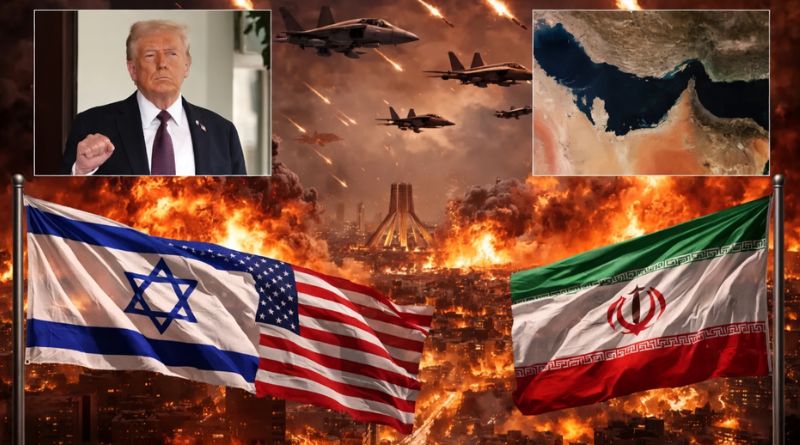
In what could represent one of the most serious escalations in Middle East tensions in decades, emerging reports and speculative scenarios describe a situation in which the United States and Israel carry out coordinated airstrikes on Iranian targets. While such developments remain unconfirmed, analysts frequently examine how a conflict of this magnitude might unfold and the far-reaching consequences it would bring. In this scenario, the operation—sometimes referred to as “Operation Epic Fury”—targets a broad network of strategic sites across Iran. These include Islamic Revolutionary Guard Corps (IRGC) command centers, ballistic missile installations, air defense systems, and facilities linked to nuclear development. Major cities such as Tehran, Isfahan, Qom, Kermanshah, and Karaj are identified as key areas. The likely objective would be to weaken Iran’s military capabilities and reduce perceived threats tied to its regional influence and nuclear ambitions. Political messaging would shape how such an operation is understood globally. U.S. officials might frame the strikes as necessary to counter imminent threats, while Israeli leadership has long emphasized Iran as a direct and existential danger. In such a context, Israel would likely present the action as preemptive defense. Claims involving high-level casualties, including senior Iranian leadership, would dramatically intensify the situation, though such reports would require strong independent verification.
Iran’s response in a comparable escalation would almost certainly be rapid and multifaceted. Military doctrine suggests the use of both direct and indirect retaliation. This could involve ballistic missile and drone strikes targeting Israel, along with attacks on U.S. military installations across the region. Bases in Qatar, the United Arab Emirates, Bahrain, Kuwait, Iraq, and Jordan could all face increased risk due to their strategic roles. A central concern in this scenario is the Strait of Hormuz, one of the most critical energy chokepoints in the world. The narrow waterway carries roughly 20 to 21 million barrels of oil per day, along with significant volumes of liquefied natural gas from Qatar. Any disruption in this corridor—even partial—could send immediate shockwaves through global energy markets. Iran has repeatedly threatened to restrict access to the strait during times of crisis. While a full and sustained closure has never occurred, the country possesses the means to disrupt shipping significantly. Through naval mines, fast-attack boats, anti-ship missiles, submarines, and electronic interference, Iran could create a high-risk environment that deters commercial traffic. Even without a formal blockade, perceived danger alone could lead shipping companies to suspend or reroute operations. The economic impact would be swift. Tanker operators and energy firms would likely reduce transit, while insurance costs—especially war-risk premiums—would surge. This alone could tighten global supply chains. Oil markets, highly sensitive to geopolitical tensions, would likely respond with sharp price increases. Analysts often suggest that even a moderate disruption could push crude prices well above current levels, with severe cases potentially exceeding $100 per barrel.
Higher energy prices would have global consequences. Rising fuel costs would increase transportation and manufacturing expenses, contributing to inflation. In the United States, gasoline prices could climb quickly, placing pressure on consumers. Major importers such as China, India, Japan, and South Korea would face particular challenges due to their reliance on Gulf energy supplies. Financial markets would likely react with volatility. While energy companies might see short-term gains, broader stock markets could decline amid uncertainty. Investors typically shift toward safer assets like gold and government bonds during crises. Economists warn that prolonged disruptions in energy supply can slow global growth and increase the risk of recession. Beyond economics, the geopolitical fallout would be significant. Iran-aligned groups, including Hezbollah and the Houthis, could expand the scope of conflict through attacks on regional targets or shipping routes. Gulf states hosting U.S. forces would face heightened exposure, raising the risk of a wider regional confrontation. At the same time, Iran’s response would likely be shaped by strategic restraint as well as retaliation. While capable of escalating, Tehran must weigh the risks of provoking overwhelming military force. Its dependence on energy exports makes a prolonged shutdown of the Strait of Hormuz economically damaging for itself as well. This balance has historically prevented extreme outcomes, even during periods of heightened tension. Ultimately, a conflict of this scale would extend far beyond the Middle East. Even the possibility of such a scenario highlights the fragility of global energy systems and geopolitical stability. Whether through direct confrontation or indirect pressure, any disruption involving Iran, the United States, and Israel would carry consequences felt across the world, affecting markets, security, and international relations alike.