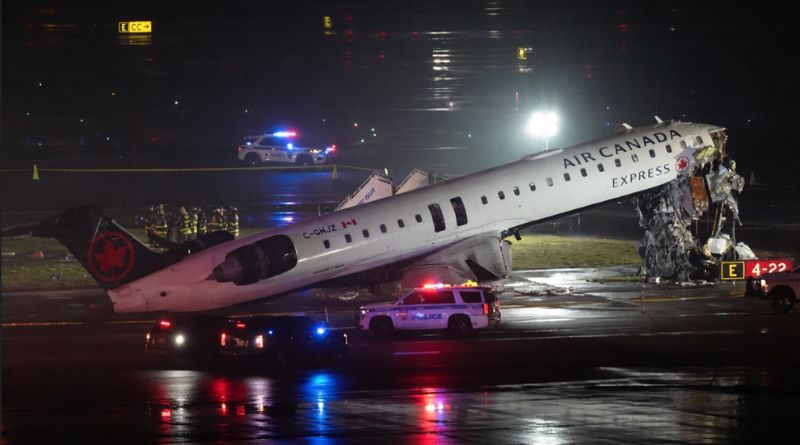
A catastrophic collision at New York’s LaGuardia Airport late Sunday night has left two pilots dead, dozens of people injured, and forced a temporary shutdown of the busy travel hub, according to aviation and law enforcement officials. The incident involved a regional Air Canada jet and a Port Authority emergency response vehicle, raising urgent concerns about runway safety and coordination procedures. The aircraft, operating as Air Canada Flight 8646 and managed by Jazz Aviation, had just completed a flight from Montreal and was in the process of landing at approximately 11:47 p.m. when the collision occurred. The plane, carrying 72 passengers and four crew members, struck a Port Authority Aircraft Rescue and Firefighting vehicle that had been responding to a separate situation on the airfield. The impact caused severe damage to the front section of the aircraft and immediately triggered a large-scale emergency response. Authorities reported that at least 41 individuals were transported to nearby hospitals for treatment. Among them were 39 passengers and two Port Authority police officers assigned to firefighting duties. While 32 of the injured were treated and later released, several others remained hospitalized with serious injuries. Officials confirmed that the two injured officers—a sergeant and another responder—were in stable condition.
Tragically, both the pilot and co-pilot of the aircraft were killed in the crash. Officials stated that their identities would not be released until their families had been formally notified. The loss of both pilots has deepened the seriousness of the incident and prompted renewed scrutiny of safety procedures governing runway operations and vehicle movement on active airfields. Despite the severity of the collision, all passengers on board the aircraft were accounted for. Among them was an unaccompanied minor, who was safely reunited with family members after the incident. Authorities emphasized that the quick and coordinated response of emergency personnel helped prevent further loss of life and ensured that passengers were evacuated and treated as efficiently as possible under the circumstances. Preliminary findings indicate that the aircraft had landed on Runway 4 and was decelerating when the collision occurred. According to early reports and air traffic control audio, the rescue vehicle had requested and received clearance to cross Runway 4 at Taxiway Delta. However, moments after granting that clearance, air traffic controllers were heard urgently instructing the vehicle to stop multiple times. The reasons why the vehicle remained in the aircraft’s path despite those warnings are now a central focus of the ongoing investigation. The National Transportation Safety Board (NTSB) has taken the lead in examining the incident and has deployed a specialized team to the crash site. The agency’s chair, along with additional investigators, arrived early Monday morning to begin a detailed review of the circumstances surrounding the collision. Officials have said the investigation will focus on several key areas, including air traffic control communications, adherence to vehicle movement protocols, visibility conditions, and the possibility of human or mechanical error.
In response to the crash, LaGuardia Airport was closed early Monday to allow investigators full access to the scene and to maintain safety during the emergency response. Authorities initially indicated the airport would remain shut down until at least mid-afternoon, though reopening timelines could shift depending on the progress of the investigation. The closure caused widespread travel disruptions, with at least 18 incoming flights diverted to nearby airports such as John F. Kennedy International Airport and Newark Liberty International Airport. Emergency services responded rapidly following the collision. Firefighters, medical teams, and law enforcement personnel worked through the night to assist passengers, secure the damaged aircraft, and manage the overall scene. Although the immediate firefighting phase has concluded, emergency crews continue to maintain a presence at the airport to support investigative efforts and ensure ongoing safety. Officials from the Port Authority and New York City Emergency Management stressed that the situation remains under active investigation and that determining the exact cause is critical. Aviation experts note that runway incursions involving ground vehicles are relatively rare but can be especially dangerous when timing errors or communication breakdowns occur. As investigators work to piece together what happened, the focus remains on supporting those affected, restoring normal airport operations, and identifying any failures that may have contributed to the crash. Authorities have emphasized that lessons learned from this incident will be essential in strengthening safety protocols and preventing similar tragedies in the future.