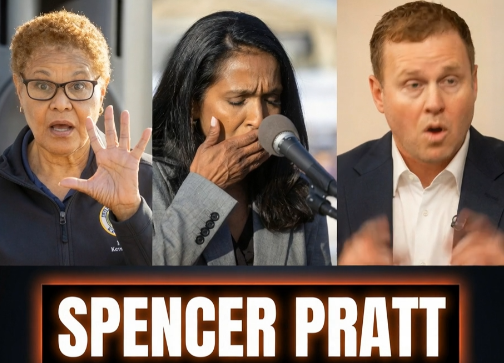
The political landscape of Los Angeles is currently defined by a state of suspended animation as election officials continue to process an immense volume of ballots following the mayoral primary. While the first-place position of incumbent Mayor Karen Bass is well-established—she currently commands roughly 35 percent of the vote and is a lock for the November runoff—the identity of her opponent remains a subject of intense speculation. At the heart of the uncertainty is Spencer Pratt, who has managed to maintain a consistent lead for the second-place spot. However, despite Pratt holding a 29.4 percent share compared to the 23.4 percent of progressive challenger Nithya Raman, the race is officially classified as “too close to call” by major media outlets and The Associated Press.
The six-point margin separating Pratt and Raman represents a substantial hurdle for the challenger, yet the mathematical possibility of a shift remains viable due to the sheer number of uncounted votes. Los Angeles County officials are working through hundreds of thousands of ballots, many of which arrived via mail. Analysts point to historical voting patterns in California, noting that ballots processed later in the cycle frequently lean more heavily toward progressive or Democratic candidates. This “blue shift” has provided a glimmer of hope for Nithya Raman, though it remains unclear if the remaining cache of votes will be sufficient to overcome the current lead held by Spencer Pratt.
The technicalities of the count are further complicated by the state’s inclusive voting laws. In California, every registered voter receives a mail-in ballot, and these votes are valid as long as they are postmarked by Election Day and received within the legal window, which extends to June 9. The process is slowed by essential security protocols, including signature verification and ballot curing, which allows voters to correct issues with their submissions. While some critics argue the process is sluggish, Orange County Registrar of Voters Bob Page has defended the system, asserting that modern procedures are actually more efficient and secure than those used in the past.
This period of uncertainty has been met with sharp criticism from the national stage. Former President Donald Trump has utilized social media to cast doubt on the integrity of the Los Angeles results, suggesting without proof that the late-arriving ballots are a sign of electoral fraud. Trump specifically targeted the mayoral contest, accusing the opposition of “stealing” the vote. These assertions were met with immediate pushback from the office of Governor Gavin Newsom, which characterized the former president’s comments as lies. This clash highlights the growing tension between administrative transparency and political messaging in the modern era.
As the daily updates from election officials continue through at least June 12, the candidates remain in a holding pattern. Spencer Pratt has projected confidence, remaining publicly optimistic about his chances of facing Karen Bass in the general election. His campaign has largely deferred to the official counts, occasionally sharing updates on platforms like X to reassure supporters. For the voters of Los Angeles, the coming days will be critical in determining whether the city’s next mayoral contest will be a centrist-versus-progressive battle or a different ideological matchup altogether.