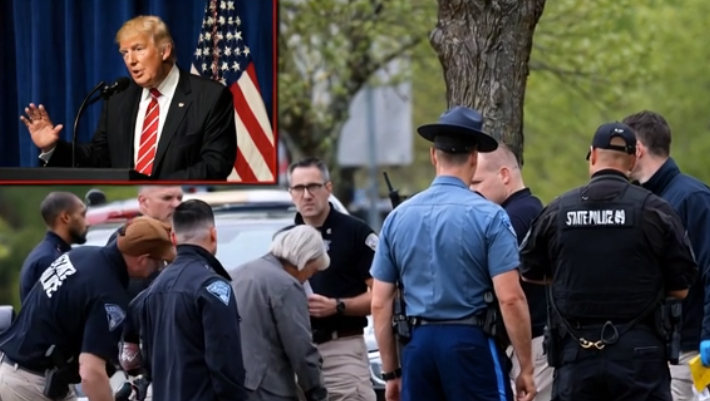
In the quiet community of Escondido, California, a local landmark known as the “Trump House” has become the site of a harrowing tragedy. Kerry Sheron, a 69-year-old U.S. Army veteran and the owner of the patriotic property, is currently fighting for his life in a trauma center following a brutal physical assault right outside his residence. The incident occurred near the intersection of East Mission Avenue and Buchanan Street, a location widely recognized across San Diego County for its elaborate displays of American flags and pro-Trump decorations. As the community reels from the violence, Sheron’s wife, Maria Garcia, has expressed a grim outlook, stating that the odds of her husband’s survival appear virtually nonexistent.
The details of the confrontation, which unfolded on a Wednesday afternoon, paint a picture of sudden and extreme violence. According to the Escondido Police Department, officers arrived at the scene to find Sheron suffering from catastrophic, life-threatening injuries. The outcome could have been even more immediate if not for the heroic intervention of a utility worker who witnessed the attack. This bystander stepped in to restrain the suspect until law enforcement could arrive, though the intervener reportedly suffered injuries of their own during the struggle. Following the assault, the suspect fled the immediate vicinity but was quickly apprehended by responding officers. The individual taken into custody has been identified as 32-year-old Thomas Caleb Butler, a U.S. Navy veteran. Butler currently faces charges of attempted murder and is being held without bail at the Vista Detention Facility. While the official investigation is ongoing, a friend of the suspect provided a complex portrait of Butler’s life, describing him as a man struggling with severe mental illness and increasing paranoia. Reports suggest that Butler had been unemployed and isolated, with his mental state deteriorating significantly in the weeks leading up to the attack. This raises critical questions about the intersection of veteran mental health services and public safety. However, for the victim’s family, the motive feels deeply tied to the visible political identity of their home. Maria Garcia believes her husband was targeted specifically because of the patriotic and political messaging that defines the “Trump House.” The property has long been a lightning rod for both support and hostility, previously serving as a target for vandalism and formal complaints. Garcia described the perpetrator as having a “black heart,” fueled by a hatred for the symbols of America and the political affiliations her husband proudly displayed. This sentiment has been echoed by California Republican Representative Darrell Issa, who has called for a “full and immediate investigation,” suggesting that Trump supporters are increasingly becoming victims of targeted political violence. As Kerry Sheron remains in critical condition within the ICU, the “Trump House” stands as a somber backdrop to a national conversation regarding political polarization and mental health. While police investigators have yet to publicly confirm a specific motive, the incident has highlighted the volatile environment surrounding public political expression. For now, a veteran who dedicated his home to his love of country finds his family bracing for the worst, while the San Diego legal system prepares to prosecute a case that sits at the center of a deeply divided social landscape.