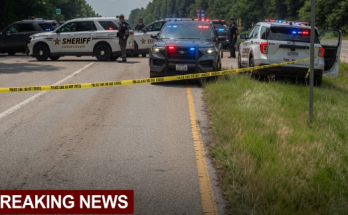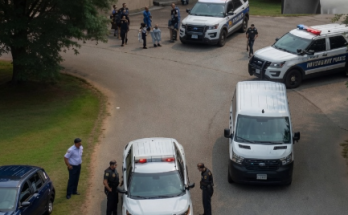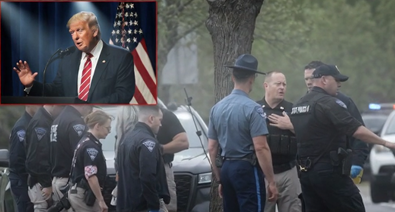
The peace of a Southern California neighborhood was shattered this week when Kerry Sheron, a 69-year-old Army veteran, became the victim of a violent assault that has left him clinging to life. Known throughout the San Diego area for his residence, famously dubbed the “Trump House,” Sheron’s home has long served as a landmark of political expression, adorned with American flags and various pro-Trump decorations. The attack occurred on a Wednesday near the intersection of East Mission Avenue and Buchanan Street, directly adjacent to the property that has attracted both significant local support and intense criticism over the years. According to emergency responders, Sheron suffered catastrophic injuries during the encounter, and he remains in critical condition within a local trauma center’s intensive care unit.
The circumstances of the assault were particularly harrowing, as police reports indicate that the violence was only halted by the quick actions of a utility worker who happened to be nearby. This bystander witnessed the attack and courageously stepped in to restrain the suspect until law enforcement arrived on the scene. While the utility worker reportedly suffered minor injuries during the struggle, their intervention is credited with potentially preventing an even more tragic outcome. Despite this, the medical prognosis for Sheron remains grim. His wife, Maria Garcia, shared a heartbreaking update with reporters, stating that she does not expect her husband to survive the trauma he endured. She described the attacker as having a “black heart” and expressed her bewilderment at the level of hatred required to carry out such a brutal act against a veteran who simply loved his country.
Law enforcement officials have identified the suspect as 32-year-old Thomas Caleb Butler, who is also a veteran, having served in the Navy. Butler was apprehended after briefly attempting to flee the scene and is currently being held without bail at the Vista Detention Facility. He faces a charge of attempted murder. While a definitive motive has not yet been established by the San Diego County authorities, the incident has sparked a firestorm of speculation regarding the role of political animosity. Maria Garcia explicitly suggested that the visible patriotic and political displays on their home—which have previously been the target of vandalism—likely fueled the suspect’s hostility. The “Trump House” has been a focal point of community division for years, making it a symbolic target in an increasingly polarized political climate.
However, a different narrative has emerged from those who knew Thomas Caleb Butler. A friend of the suspect described him as a man struggling with severe and deteriorating mental health issues. According to this source, Butler had become increasingly paranoid and unstable in recent months, often sequestering himself in his room with the belief that people were “coming to get him.” Despite being a veteran and a hobbyist who enjoyed Star Wars and Legos, his transition to civilian life appeared difficult, and he had remained unemployed. His friend noted that while Butler was on medication for mental illness, his condition had worsened significantly leading up to the day of the attack. This suggests that the violence may have been the result of a psychological break rather than a calculated political statement, though the two factors may not be mutually exclusive.
The political ramifications of the event were immediate. California Republican Representative Darrell Issa took to social media to demand a “full and immediate investigation” into the assault. Issa suggested that this incident is part of a broader, more disturbing trend where supporters of President Trump are being targeted by “leftist violence” across the nation. This framing has intensified the national spotlight on the case, as observers wait to see if investigators will officially classify the attack as a hate crime or a politically motivated assault. Regardless of the eventual legal classification, the tragedy has deeply affected the local community, which viewed the “Trump House” as a testament to Sheron’s unapologetic display of American pride.
As Kerry Sheron continues his fight for survival in the ICU, the legal process against Thomas Caleb Butler is just beginning. The community remains on edge, grappling with the reality of a veteran being attacked on his own doorstep. The story serves as a somber reminder of the potential for violence in an era of high political tension and the critical need for better mental health support for veterans. For now, the San Diego police continue to gather evidence and interview witnesses to piece together the final moments before the confrontation, while a family prepares for a future without their patriarch.