Digital Echo Chambers: The Anatomy of Recent Speculation Surrounding Donald Trump’s Health
In the high-stakes environment of modern politics, the intersection of public visibility and digital speed often creates a volatile landscape for information. This phenomenon was recently illustrated when Donald Trump became the focus of intense online speculation following minor adjustments to his public schedule. As a prominent figure whose every move is scrutinized, even a slight deviation from a routine calendar can ignite a firestorm of unverified claims across the internet. The speed at which these rumors traveled underscores a critical challenge in the 21st-century media ecosystem: the struggle to maintain factual integrity in an age where engagement often takes precedence over accuracy.
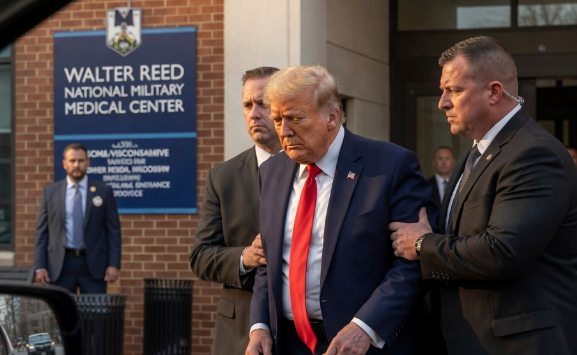
The specific incident began with reports suggesting that the former president had been admitted to the Walter Reed National Military Medical Center. While these claims were initially baseless, they found a fertile breeding ground on social media platforms such as X (formerly Twitter), Facebook, and various digital forums. The lack of immediate, granular detail regarding a schedule change for April 4 acted as a vacuum that was quickly filled by assumptions and dramatic narratives. This case serves as a quintessential example of how unverified information can achieve significant reach, influencing public perception before official sources have the opportunity to provide clarity.
The role of algorithmic amplification cannot be overlooked in this context. Platforms like X and Facebook are designed to prioritize content that generates high levels of interaction. Because health-related news concerning a former president is inherently sensational, the rumors regarding Walter Reed were pushed to the forefront of user feeds, regardless of their lack of evidence. This created a feedback loop where the more people discussed the potential emergency, the more the platforms suggested the topic to others, leading to a surge in confusion and concern among both supporters and the general public.
To combat the rising tide of misinformation, official representatives eventually issued firm statements. These clarifications stated explicitly that there was no medical emergency and that the reports of hospitalization at Walter Reed were entirely inaccurate. By providing a direct rebuttal, authorities aimed to stabilize the narrative and reassure the public. However, the incident highlighted the inherent lag between the birth of a digital rumor and the deployment of a factual correction, a gap that often allows misinformation to take deep root in the public consciousness.
Adding context to the discussion, the summary notes that while interest in a leader’s health is standard, it must be balanced with factual history. In the past, it was disclosed that Donald Trump had been diagnosed with chronic venous insufficiency. This is a common medical condition, particularly among older populations, involving the inefficient movement of blood from the leg veins back to the heart. While this condition requires standard medical monitoring and lifestyle management, officials have stressed that it was not a factor in the recent schedule changes, nor did it necessitate any emergency intervention. The conflation of past manageable conditions with current speculative emergencies is a common tactic in the spread of digital misinformation.
The public reaction to these events was divided, reflecting the polarized nature of modern discourse. Some observers expressed genuine concern for the former president’s well-being, while others maintained a stance of skepticism, calling for verified reports from reputable news outlets. This divide emphasizes the necessity of media literacy. In an era where the barrier to entry for publishing is non-existent, the responsibility falls on the consumer to distinguish between sensationalist clickbait and verified journalism. Fact-checking organizations played a vital role during this period, working to debunk the Walter Reed rumors and reminding audiences of the dangers of reactive sharing.
Furthermore, the incident sheds light on the immense pressure placed on public figures to maintain a consistent presence. For a figure like Donald Trump, whose public identity is built on an image of high energy and constant activity, a single cancelled event is viewed not as a personal or logistical necessity, but as a potential sign of crisis. This level of scrutiny creates a challenging environment for communication teams, who must balance the need for privacy with the public’s demand for transparency to prevent the spread of misinformation.
Ultimately, the lessons from this episode are clear. First, the speed of digital information requires a higher standard of individual caution. Second, the importance of verified information from official sources cannot be overstated when navigating health-related claims. Third, the incident serves as a reminder to the media and the public alike that transparency is the best defense against speculation. As the digital landscape continues to evolve, the ability to navigate these waves of misinformation will remain a vital skill for an informed citizenry. At present, Donald Trump continues his regular activities, and the surge of speculation has subsided, leaving behind a valuable case study in the dynamics of modern media and public trust.