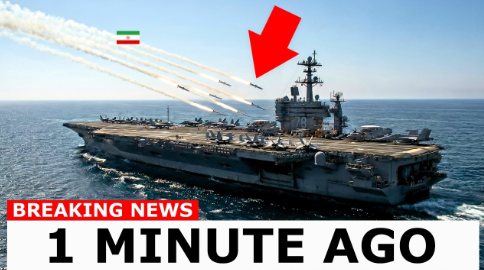
In the high-stakes environment of the Arabian Sea, a hypothetical yet harrowing scenario unfolds, testing the limits of United States naval supremacy. The narrative centers on the USS Gerald Ford, the world’s most advanced aircraft carrier, as it faces a sophisticated saturation attack from Iran. This fictional engagement involves the launch of eight Khorramshahr missiles, a formidable weapon in the Iranian arsenal known for its 2,000-kilometer range. The tactical brilliance of the attack lies in its deception: seven of the incoming projectiles are high-fidelity decoys, while only one carries a lethal 1,500-kilogram high-explosive warhead. This maneuver is designed to overwhelm the ship’s sensors and deplete its defensive magazine, a classic Anti-Access/Area Denial (A2/AD) tactic that presents a nightmare scenario for modern naval commanders. At the center of the carrier’s defense is the Aegis Combat System, an integrated suite of sensors and weapons designed to neutralize multi-domain threats. As the missiles approach, the Aegis system launches a flurry of interceptors, attempting to thin the herd of incoming threats. However, the complexity of the decoys causes the system to exhaust its entire ready-to-fire inventory. In a chilling turn of events, the interceptor count hits zero while two unidentified contacts remain on a terminal trajectory toward the ship. The failure of the automated systems to distinguish the real warhead from the decoys highlights a critical vulnerability in even the most expensive military hardware: the reliance on algorithmic processing that can be spoofed by clever physical engineering.
The narrative shifts from technological prowess to human intuition through the actions of Lieutenant Rachel Webb. While her superiors are occupied with the broader operational chaos of the fleet, Webb maintains a singular, intense focus on the incoming data. Just 51 seconds into the engagement, she identifies a minute 0.3 percent difference in the exhaust plume of the projectile labeled Contact 6. This subtle thermal signature variance, caused by the mass of the 1,500kg warhead compared to the lighter decoys, is the only clue to the true threat. Her 14-minute vigil over this single data point represents the vital “human-in-the-loop” element that remains indispensable in the era of automated warfare. Her observation provides the split-second advantage needed to reorient remaining defenses toward the actual danger. This scenario serves as a profound meditation on the shifting nature of maritime conflict in the 21st century. The rise of regional powers with advanced ballistic capabilities, such as Iran, challenges the long-standing assumption that U.S. Navy carrier strike groups are invulnerable. The cost-exchange ratio is heavily skewed in favor of the attacker; a single Khorramshahr missile is significantly cheaper than the multi-billion-dollar USS Gerald Ford it seeks to destroy. The engagement underscores the necessity for the Pentagon to invest not only in better kinetic interceptors but also in advanced sensor fusion and directed-energy weapons that can identify and neutralize decoys without depleting a ship’s limited physical ammunition. Ultimately, the story of the USS Gerald Ford’s stand in the Arabian Sea is a reminder that vigilance and adaptation are the cornerstones of military survival. While the aircraft carrier stands as a massive symbol of American power, its safety depends on the razor-thin margin of error provided by individuals like Lieutenant Rachel Webb. As nations continue to develop hypersonic and asymmetric weapons, the balance of power will likely be determined by who can better integrate machine speed with human insight. This fictional clash provides a stark warning: in the future of naval combat, the difference between victory and catastrophe may be as small as a 0.3 percent plume variance observed by a single, dedicated officer.