In the modern digital landscape, the boundary between public interest and private health has become increasingly porous. A recent and profound example of this phenomenon is the surge of online speculation surrounding the well-being of former U.S. President Donald Trump. This incident serves as a critical case study for the media industry and professional journalists, illustrating how a minor deviation in the routine of a high-profile figure can be amplified into a global crisis narrative. The event highlights the precarious nature of our current information ecosystem, where the speed of social media often outpaces the deliberate pace of factual verification.
The specific wave of misinformation began following a routine adjustment to the schedule of Donald Trump, who was noted to be absent from events on April 4. Historically, the former president has maintained a highly visible and demanding public itinerary. When this pattern was suddenly interrupted without an immediate, detailed explanation, it created what analysts call an informational vacuum. In such voids, the public is often unwilling to wait for official statements, leading individual users to fill the silence with conjectures that quickly solidify into perceived reality through collective repetition across digital platforms.
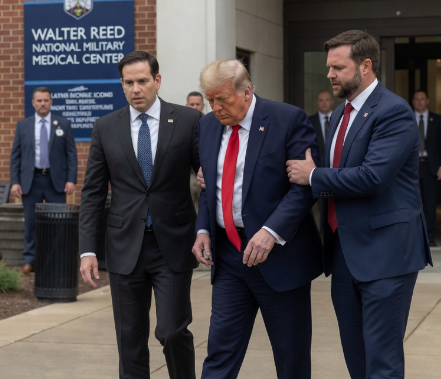
As the vacuum persisted, specific and alarming claims began to take root. The most widely disseminated rumor suggested that Donald Trump had been rushed to Walter Reed National Military Medical Center for emergency treatment. This narrative gained significant traction on platforms like X (formerly Twitter), Facebook, and various political forums. Despite the absolute absence of photographic evidence—such as motorcade sightings or hospital activity—the claims were shared millions of times. This was fueled by digital algorithms designed to boost high-engagement content, which frequently favors sensationalism over the mundane truth of a scheduling conflict.
The ‘snowball effect’ of this misinformation underscores a systemic vulnerability in public discourse. Once a narrative reaches a certain velocity, users begin to view it as credible simply because of its ubiquity. During this particular episode, the confusion was widespread, affecting both political observers and the general public. The transition from a simple lack of public appearance to a rumored medical emergency at Walter Reed demonstrates how easily unverified information can be weaponized or accidentally amplified to cause social unrest and concern.
The situation eventually necessitated a formal intervention. Official representatives for Donald Trump issued statements to clarify that the former president was at his residence and continuing his work. By directly refuting the Walter Reed rumors, these officials were able to dampen the speculative fire. This highlights the vital role that transparent communication plays in the digital age. When official sources are slow to respond, they inadvertently allow misinformation to become the dominant narrative, making the subsequent correction much harder to establish as the definitive truth.
To contextualize the public’s heightened sensitivity, it is worth noting past medical disclosures regarding Donald Trump. Medical records have previously mentioned a condition known as chronic venous insufficiency. While this condition, which affects leg vein valves, is common among older individuals and manageable through routine care, it had no connection to the events of early April. However, the existence of any known medical history often provides just enough ‘factual’ anchoring for theorists to build more elaborate and false stories of acute medical crises.
The reaction to these rumors also revealed a significant divide in public behavior. While many users acted as conduits for the false story, a segment of the audience demonstrated high media literacy, urging others to wait for verified information. This tension reflects the broader struggle between the human impulse for immediate news and the journalistic requirement for accuracy. Fact-checking organizations played a crucial role in this instance, working alongside traditional media to debunk the hospital claims and remind the public of the dangers inherent in unverified social media posts.
For the media industry, this episode is a stark reminder of the ethical burden of reporting. Reputable outlets faced the challenge of acknowledging the trending rumor without giving it unearned legitimacy. Most established journalists opted for a cautious approach, waiting for official confirmation before addressing the hospital claims. This commitment to verification remains the primary differentiator between professional journalism and the chaotic speculation found on decentralized platforms. Maintaining this standard is essential for preserving public trust in an era of rampant misinformation.
Ultimately, the events surrounding the April 4 schedule change offer several warnings. First, in a hyper-connected world, the absence of news is often treated as a signal for speculation. Second, the architecture of social media is currently optimized for viral sensation rather than factual accuracy. Finally, the stability of public discourse depends on the speed of official responses and the critical thinking skills of the citizenry. As of the latest reports, Donald Trump remains active in his duties, and the incident has transitioned from a medical rumor to a cautionary tale about the power of digital misinformation.