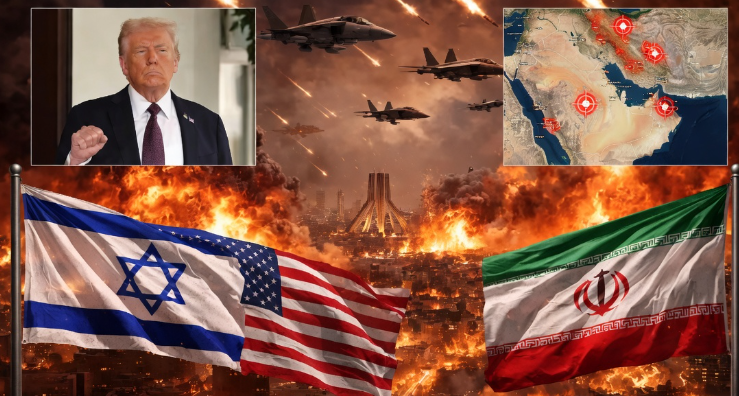
In a watershed moment for international relations, the United States and Israel have launched a massive, multi-front military offensive against the Islamic Republic of Iran. Named Operation Epic Fury, the campaign represents the most aggressive direct engagement in the Middle East in several decades. The initial strikes targeted high-value military infrastructure belonging to the Islamic Revolutionary Guard Corps (IRGC), specifically focusing on ballistic missile launch sites, integrated air defense networks, and critical command-and-control centers. Major strikes were reported across several Iranian provinces, including the capital of Tehran, as well as Isfahan, Qom, Kermanshah, and Karaj. This escalation follows justifications from President Donald Trump, who characterized the strikes as a preemptive defensive necessity against Iran’s nuclear ambitions, while Prime Minister Benjamin Netanyahu described the operation as a vital response to an “existential threat” against the state of Israel.
The political ramifications of Operation Epic Fury are profound and suggest a significant departure from previous US foreign policy. While Israeli intelligence agencies have circulated reports suggesting the possible death or incapacitation of Supreme Leader Ali Khamenei, Iranian state media has countered these claims, insisting the leader remains safe and in control. Perhaps more significantly, the White House has signaled a pivot from containment to a strategy of active regime change. Donald Trump has used the offensive to publicly call upon the Iranian populace to seize the opportunity to reclaim their sovereignty from theocratic rule. This shift has essentially frozen all diplomatic channels, ending any prospect of a negotiated settlement regarding the Iran nuclear deal and plunging the region into a state of total uncertainty.
Iran’s response was both swift and expansive, targeting US and allied interests throughout the Persian Gulf. Within hours of the initial bombardment, the IRGC deployed a sophisticated array of ballistic missiles and suicide drones. These retaliatory measures were not restricted to Israel; instead, they struck a network of US military installations across several sovereign nations. Strategic hubs such as Al Udeid in Qatar, Al Dhafra in the United Arab Emirates, the Fifth Fleet headquarters in Bahrain, and Ali Al Salem in Kuwait reported being under fire. This widening of the battlefield has terrified global observers, as it marks the beginning of what could be a full-scale regional war involving the world’s most significant energy-producing nations.
Central to the escalating crisis is the effective closure of the Strait of Hormuz, the world’s most vital energy artery. The IRGC Navy has reportedly utilized VHF Channel 16 to issue stern warnings to all international commercial vessels, declaring that transit through the narrow waterway is now “not allowed” and “unsafe.” These warnings have been confirmed by international maritime monitors, including the European Union’s Operation Aspides and the United Kingdom’s Maritime Trade Operations (UKMTO). While Tehran has stopped short of a formal blockade decree—likely to avoid immediate total economic isolation—their tactical enforcement on the water has brought shipping traffic to a virtual standstill.
The global energy market has reacted with predictable panic. Real-time data from Kpler and Bloomberg show that a massive fleet of oil tankers and LNG carriers has halted operations, with many vessels choosing to anchor in safe waters or begin the arduous and expensive process of rerouting around the Cape of Good Hope. The US Navy has added to the atmosphere of uncertainty by advising commercial fleets that it cannot currently guarantee safe passage in the Persian Gulf. This has led major energy firms and trading houses to suspend all transit, effectively paralyzing a route that handles approximately 20% of global oil consumption, or roughly 21 million barrels per day.
The strategic importance of the Strait of Hormuz is unparalleled. For major producers such as Saudi Arabia, Iraq, Kuwait, the UAE, and Qatar, this 21-mile-wide chokepoint is the only viable exit for their exports. A prolonged closure would necessitate global shipping shifts that would increase operational costs and transit times exponentially. Historically, Iran has used the threat of closure as a diplomatic lever, but the current situation is far more severe than the “maximum pressure” era of 2019. Despite the US strikes degrading some traditional Iranian naval assets, the IRGC maintains robust asymmetric capabilities, including naval mines, fast-attack swarms, and shore-based anti-ship missiles, allowing them to exert control without needing conventional naval superiority.
Financial analysts are forecasting a period of extreme volatility as markets reopen. Experts from Barclays and Rapidan Energy have warned that Brent crude prices could easily surge past $100 per barrel, with a worst-case scenario of a sustained blockade pushing prices toward $150. Such a spike would introduce a massive “war-risk premium” to the global economy, driving up inflation and eroding consumer confidence worldwide. Asian economies, particularly China, India, Japan, and South Korea, are exceptionally vulnerable due to their reliance on crude imports from the Middle East. In the United States, the domestic impact could be seen at the pump, with gasoline prices potentially hitting $6 per gallon, further straining the manufacturing and transportation sectors.
The broader geopolitical landscape remains fraught with peril as Iranian proxies prepare to enter the fray. Groups like the Houthis in Yemen and Hezbollah in Lebanon have already signaled their intent to expand the scope of attacks against Israeli and Western interests in the Red Sea and beyond. This coordinated military action follows a pattern of recent US interventions elsewhere, such as in Venezuela, suggesting a more assertive and interventionist American foreign policy. As of February 28, 2026, the international community is at a crossroads. The choice remains between a desperate attempt at de-escalation via back-channel diplomacy or a descent into a full-scale maritime war that could trigger a global economic recession of unprecedented proportions.