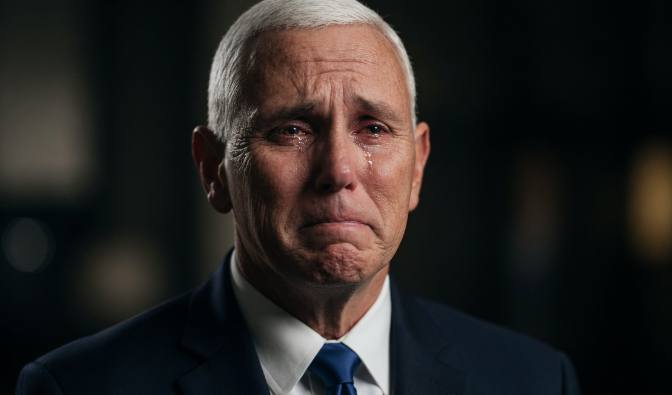
Former Vice President Mike Pence continues to navigate the complex political landscape of the Republican Party, attempting to maintain his relevance while positioning himself as a principled critic of his former running mate, Donald Trump. In a series of media appearances, Pence has sought to define a “constructive” role for himself within the party, even as he openly challenges the shift toward isolationism. This delicate balancing act was on full display during a recent interview on CNN, where he addressed the evolving foreign policy dynamics regarding Russia and the ongoing conflict in Ukraine. Speaking with anchor Kate Bolduan, Pence weighed in on controversial reporting regarding Pete Hegseth and an alleged unilateral decision to halt arms supplies to Ukraine. The former Vice President expressed deep concern over reports that the Pentagon had paused critical shipments without the explicit knowledge of Donald Trump. While Pence acknowledged the massive scale of federal bureaucracy, he described the lack of presidential oversight on such a significant decision as “troubling.” He did, however, praise the eventual reversal of this decision, noting that Trump reaffirmed U.S. support during a phone call with President Zelenskyy.
However, Pence went a step further by offering a direct recommendation to the administration regarding the nature of U.S. aid. He argued that defensive weaponry alone is insufficient for Ukraine to achieve a lasting peace. Instead, Pence advocated for providing the Ukrainian military with “offensive capability” and robust protection against aerial assaults. This stance puts him at odds with the “isolationists” in the GOP, whom Pence claims are losing momentum following their criticisms of U.S. actions regarding Iran’s nuclear facilities. The rift between Pence and Trump extends beyond Eastern Europe to the broader history of American foreign intervention. Pence recently took aim at Trump for comments made during a speech in Saudi Arabia, where the President denounced “nation-builders” and questioned the efficacy of U.S. interventions in the Middle East. Trump had characterized previous efforts in Iraq and Afghanistan as the work of “interventionists” who failed to understand the complex societies they sought to change, contrasting them unfavorably with local development seen in Riyadh and Abu Dhabi. In a subsequent interview on NBC’s Meet the Press, Pence characterized these remarks as a “disservice” to the generations of Americans who served in the Global War on Terror. He expressed a fundamental disagreement with the practice of an American president criticizing U.S. foreign policy while on foreign soil. Pence found it particularly “unfortunate” that such a critique was delivered in Saudi Arabia, pointedly noting that the majority of the 9/11 hijackers hailed from that nation. By defending the legacy of U.S. service members, Pence seeks to distinguish his traditional conservatism from Trump’s “America First” skepticism. As the GOP looks toward the future, Mike Pence remains determined to act as a “constructive force” for the conservative agenda. While he remains one of the few high-profile Republicans prepared to formally challenge the President’s rhetoric, his ability to endear himself to the MAGA base remains uncertain. By positioning himself as a guardian of traditional foreign policy, Pence is betting that there is still a significant appetite for a brand of conservatism that prioritizes U.S. global leadership and military honor.