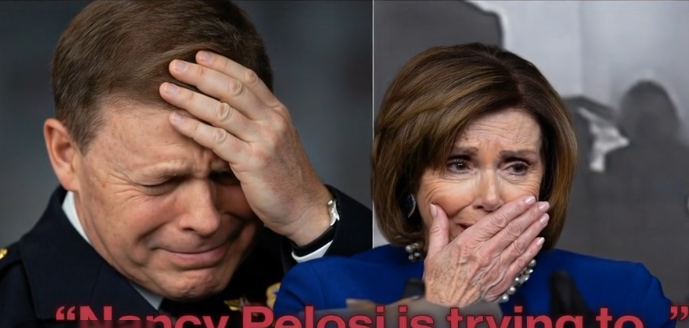
A heated political confrontation has erupted between former House Speaker Nancy Pelosi and Steven Sund, the former chief of the U.S. Capitol Police, over the security failures of January 6, 2021.
The dispute was reignited after Pelosi publicly condemned President Donald Trump’s recent decision to implement a sweeping federal crime crackdown in Washington, D.C., which includes activating the D.C. National Guard and taking control of the Metropolitan Police Department. Pelosi accused Trump of hypocrisy, claiming he delayed the National Guard during the Capitol riot while now deploying them as a distraction from his administrative policy shifts. In a scathing response, Steven Sund issued a direct “fact check” to the former Speaker, accusing her of dishonesty regarding the events leading up to the riot. Sund asserted that he formally requested National Guard support as early as January 3, 2021, but was blocked by Pelosi’s own House Sergeant at Arms. Under federal law 2 U.S.C. §1970, Sund was prohibited from calling in the Guard without specific authorization from the Capitol Police Board, which includes the Sergeant at Arms. He further claimed that on the day of the attack, his urgent requests for assistance were stalled for over 70 minutes while officials allegedly waited for approval from Pelosi’s office. The controversy is bolstered by resurfaced footage from an HBO documentary, filmed by Pelosi’s daughter, showing the Speaker expressing a personal desire to physically confront Trump on January 6. This has led critics to question why Pelosi seemed more focused on political optics than the immediate security authorization required by the Capitol Police. Meanwhile, Trump has framed his new D.C. security measures as a “liberation day” for the capital, targeting violent gangs and crime under the Home Rule Act. Defense Secretary Pete Hegseth confirmed that troops will serve as “force multipliers” for local law enforcement during this 30-day operation. The debate also highlights the role of D.C. Mayor Muriel Bowser, who has expressed unease over the current federal takeover. However, archival records show that prior to January 6, Bowser sent a formal letter to the Pentagon and the Department of Justice specifically discouraging the deployment of additional federal law enforcement personnel. This historical context, combined with Sund’s testimony, complicates the long-standing Democratic narrative that Trump was solely responsible for the security delays. As Trump exercises his renewed executive authority over Washington, D.C., the battle over the historical record of the Capitol riot remains a central and polarizing fixture of American politics.