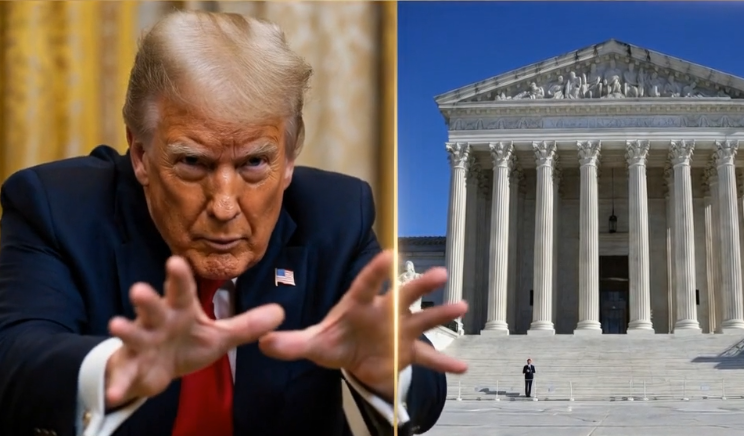
In a historic and unprecedented move, President Donald Trump attended oral arguments at the U.S. Supreme Court this Wednesday, marking the first time a sitting president has personally observed the nation’s highest judicial proceedings.
Despite the gravity of the occasion, Trump’s presence was short-lived. He departed the courtroom after approximately one hour, leaving shortly after U.S. Solicitor General John Sauer concluded the government’s presentation. By exiting before the plaintiff began her arguments, the President appeared to focus solely on the federal government’s defense of his controversial executive actions. The legal battle at the center of this appearance concerns the constitutionality of an order aimed at terminating birthright citizenship for children born on U.S. soil to parents who are in the country either temporarily or illegally. This case challenges deep-seated interpretations of the U.S. Constitution and the extent of the 14th Amendment. Representing the administration was John Sauer, the former Missouri solicitor general who was appointed to his current federal role by Trump in April 2025. Sauer now oversees critical appellate advocacy for the Justice Department. The case raises fundamental questions about national identity and the scope of executive power. Supporters of the President’s order argue that the current interpretation of citizenship provides an “incentive” for illegal immigration, while critics maintain that the Constitution provides an absolute guarantee of citizenship to all born within the United States jurisdiction. The outcome of these deliberations will have profound implications for immigration policy and the legal status of thousands of families across the nation. Following his abrupt departure from the Supreme Court, Trump took to his social media platform, Truth Social, to reiterate his stance. In a pointed post, he characterized the current birthright citizenship laws as a sign of national weakness, claiming the United States is the only country “STUPID enough” to maintain such a policy. This public rhetoric highlights the ongoing friction between the executive branch and established legal norms as the Supreme Court prepares its final ruling.