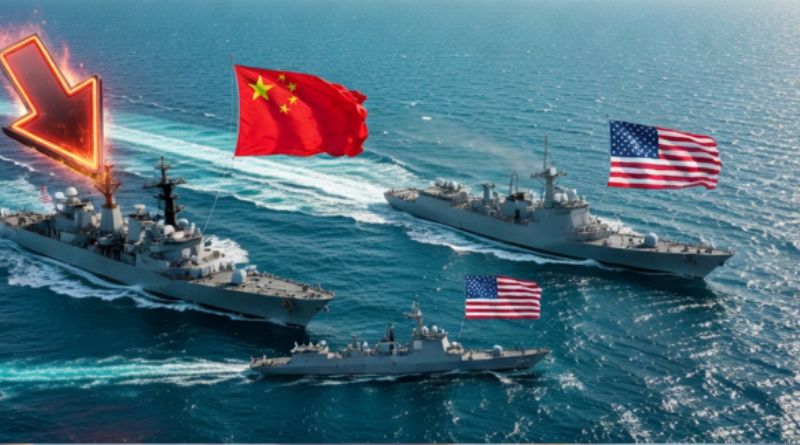
A routine naval operation in the South China Sea recently came close to escalating into a serious international crisis. A Chinese destroyer was reportedly ordered to intercept the USS Nimitz, one of the most powerful aircraft carriers in the U.S. Navy. The encounter quickly turned into a tense standoff, highlighting the risks of military activity in one of the world’s most disputed regions.
The South China Sea has long been a source of geopolitical friction, with China, Vietnam, the Philippines, and other nations asserting overlapping territorial claims. The United States, while not a claimant, regularly conducts freedom of navigation operations to challenge what it considers excessive maritime restrictions. China, however, views these missions as violations of its sovereignty, often responding with military deployments of its own. The USS Nimitz, a massive vessel displacing more than 100,000 tons and carrying around 6,000 personnel, represents a significant projection of American naval power. Its air wing, including advanced fighter jets like the F/A-18 Super Hornet, allows it to operate across vast distances. The Chinese destroyer involved in the encounter was also heavily equipped, featuring modern missile systems and sophisticated radar capabilities.
As the two forces approached each other, tensions rose sharply. Fighter aircraft were launched, electronic warfare systems were activated, and both sides maneuvered with extreme caution. Each movement was deliberate, designed to send a message without provoking direct conflict. The situation became a high-stakes test of discipline and strategy, where even a minor miscalculation could have led to serious consequences. Ultimately, the standoff did not escalate into confrontation. Military communication channels and established protocols likely played a crucial role in maintaining control. The incident serves as a reminder of the fragile balance in the South China Sea and the constant risk of miscalculation in such a volatile environment.