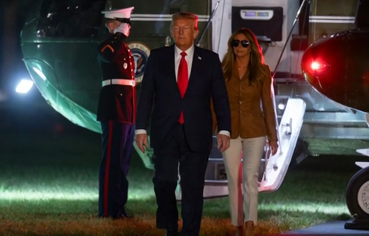
President Donald Trump and First Lady Melania Trump encountered a brief travel disruption during their high-stakes state visit to the United Kingdom when their Marine One helicopter was forced to make an unplanned emergency landing. According to Press Secretary Karoline Leavitt, the aircraft experienced a “hydraulics issue” that prompted pilots to land at a local airfield out of an abundance of caution before reaching Stansted Airport. While the incident extended a 20-minute flight into a 40-minute journey, the President and First Lady safely transferred to a support helicopter and continued their itinerary without further complication.
The centerpiece of the visit was a series of high-level diplomatic and economic engagements. After being welcomed by King Charles III and Queen Camilla at Windsor Castle, the President traveled to Chequers, the official country residence of Prime Minister Keir Starmer. Following private discussions that touched on critical global issues—including the Gaza war, the conflict in Ukraine, environmental policy, and free speech—the two leaders announced a massive £250 billion mutual investment package. President Trump characterized the US-UK alliance as the “most natural partnership in the world,” framing the visit as a pivotal moment for bilateral economic growth.
Central to the diplomatic success was the unveiling of the “tech-prosperity deal,” an accord designed to align the two nations through deregulation and rapid innovation. The agreement focuses on cutting-edge sectors such as artificial intelligence (AI), quantum computing, 6G, and fusion energy. During a reception with top business executives, including Nvidia’s Jensen Huang and Blackstone’s Steve Schwarzman, Trump highlighted that the accord had already spurred a private-sector wave of deals worth over $350 billion. Notably, Blackstone committed $136 billion, a move the President praised as a cornerstone of the new economic framework.
The deal also places a heavy emphasis on energy infrastructure and the aerospace supply chain. Trump underscored the importance of the UK’s world-class aerospace assets and announced a major partnership between the American firm X Energy and British company Centrica. This collaboration aims to deploy modular nuclear reactors across the United Kingdom, a project estimated to generate $50 billion in economic value, create 2,500 specialized jobs, and provide power to approximately 1.5 million homes. The President noted that massive electricity generation is a prerequisite for dominating the future of AI, linking the modern initiative to the legacy of British computing pioneer Alan Turing.
As the visit concluded, the President reiterated his commitment to a shared future defined by technological dominance and scientific partnership. By fostering deeper cooperation between the U.S. and UK governments, academic institutions, and private sectors, the administration hopes to secure a leading position in the global race for emerging technologies. Following the successful completion of these talks and the finalization of the investment framework, President Trump returned to the White House on Friday, marking the end of a productive and historic overseas mission.