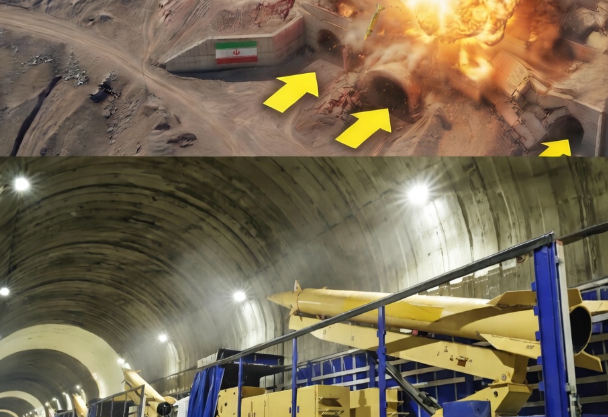
For decades, the Islamic Republic of Iran relied on a defense strategy built around subterranean invulnerability, investing billions into “missile cities” and nuclear facilities like Fordow
and Isfahan. This doctrine assumed that mountain ranges and reinforced concrete provided a permanent shield against conventional military strikes. However, the execution of Operation Epic Fury has shattered this long-standing perception. Over a 72-hour period, the United States Air Force deployed a lethal combination of B-2 Spirit, B-1 Lancer, and B-52 Stratofortress bombers to conduct surgical strikes that bypassed the regime’s most sophisticated defenses. Central to the operation’s success was the deployment of the GBU-57 Massive Ordnance Penetrator (MOP). This 30,000-pound bunker-buster was specifically engineered to penetrate deep layers of granite and reinforced concrete. By focusing on critical vulnerabilities such as ventilation shafts and surface entrances, U.S. forces effectively sealed underground networks, rendering them inoperable. Intelligence reports suggest that approximately 80 to 90 percent of Iran’s strategic ballistic missile and drone stockpiles were annihilated, representing a catastrophic loss of military infrastructure and a total collapse of their underground logistical capacity. The consequences of these strikes extend far beyond the borders of Iran. The destruction of these stockpiles has severed the logistical lifelines for the Axis of Resistance, significantly weakening regional proxies like Hezbollah in Lebanon and the Houthis in Yemen. Without the consistent flow of Iranian weaponry and operational support, these groups find their capabilities severely diminished. This shift has fundamentally altered the regional balance of power, leaving Tehran with a fraction of its former influence and forcing its leadership to confront a new, vulnerable reality. Ultimately, Operation Epic Fury signals the end of an era where geographical depth guaranteed security. The success of B-2 stealth technology and precision-guided munitions proves that even the most fortified underground sanctuaries are within reach of modern airpower. This event has forced a global reassessment of defensive strategies, as military planners worldwide realize that “missile cities” may now serve as tombs rather than shields. As the Middle East enters this period of strategic uncertainty, the message is clear: in the age of advanced munitions, geographical depth no longer guarantees protection.