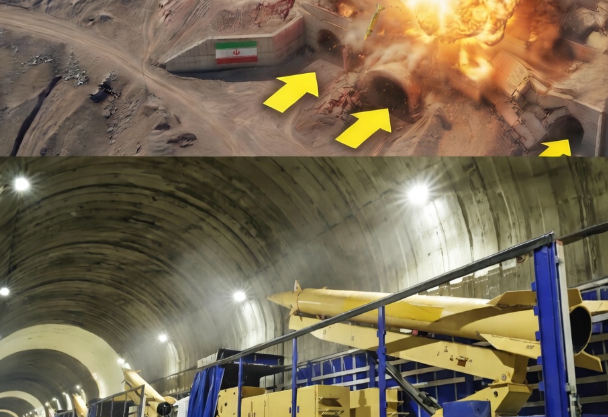
In a decisive shift in modern warfare, the long-standing strategic doctrine of the Islamic Republic of Iran has been dismantled. For decades
, Tehran invested billions into the construction of “missile cities” and nuclear facilities buried deep beneath mountain ranges, assuming these subterranean strongholds were beyond the reach of conventional military technology. However, the execution of Operation Epic Fury has fundamentally altered this perception. Over a 72-hour window, the United States Air Force, deploying a fleet of B-2 Spirit, B-1 Lancer, and B-52 Stratofortress bombers, conducted surgical strikes that bypassed the most sophisticated defensive measures. The operation utilized the GBU-57 Massive Ordnance Penetrator (MOP), a 30,000-pound bunker-buster designed specifically to reach targets hidden under layers of reinforced concrete and granite. By targeting critical vulnerabilities such as ventilation shafts and surface entrances at key sites like Fordow and Isfahan, U.S. forces managed to permanently seal these facilities. Intelligence estimates indicate that between 80 to 90 percent of Iran’s strategic ballistic missile and drone stockpiles were destroyed in the onslaught. This catastrophic loss has effectively severed the logistical support lines for the Axis of Resistance, leaving regional proxies like Hezbollah in Lebanon and the Houthis in Yemen without their primary source of operational backing. The success of the campaign relied on a combination of stealth technology and meticulous tactical planning. The B-2 stealth bomber played a pivotal role, penetrating Iranian airspace undetected to deliver ordnance with unmatched precision. Rather than engaging in a protracted ground conflict, the U.S. focused on neutralizing the operational capacity of the underground networks. This approach has not only crippled Iran’s immediate military infrastructure but has also forced a total reassessment of defensive strategies worldwide. The once-vaunted “missile cities” are now viewed as potential tombs for high-value assets rather than invulnerable sanctuaries. As the dust settles, the regional balance of power has undergone a dramatic transformation. While Tehran may eventually attempt to rebuild its military capabilities or adapt its strategies to counter current American airpower, the immediate geopolitical reality is one of severely diminished Iranian influence. The international community now watches closely as the Middle East enters a new era of strategic uncertainty. Operation Epic Fury serves as a stark demonstration that in the age of advanced precision munitions, geographical depth no longer guarantees security, and the era of underground invulnerability has officially come to an end.