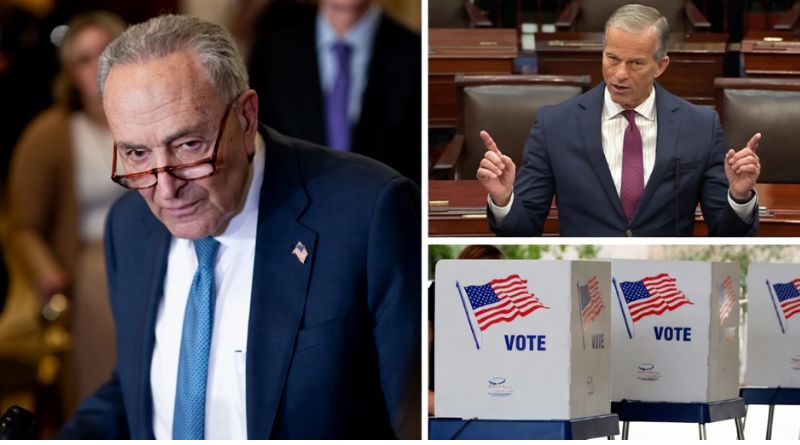
Senate Republican Leader John Thune indicated that Republicans are ready to consider forceful legislative strategies to pass the SAVE America Act, including the potential use of budget reconciliation to overcome Democratic resistance in the Senate.
Speaking after a meeting with fellow Republican senators, Thune said there is growing support within the party for using reconciliation if it becomes necessary. While he emphasized that such a move should be justified, he acknowledged that the circumstances may soon warrant it.
“I’ve said before that budget reconciliation requires a reason,” Thune said. “If those reasons are there—and they may very well be—I think there’s significant support among our colleagues for pursuing that route.”
Thune also pointed out that Republicans have multiple legislative options available and are prepared to use them strategically to ensure the bill advances. With Democrats likely to oppose the measure, he suggested that relying solely on the traditional 60-vote threshold may not be practical.
“We have two legislative vehicles available to us,” he said. “We can move forward with one of them if needed. If using a process that allows us to pass this with a simple majority is what it takes, we’ll take a serious look at it.”
Under Senate rules, reconciliation allows certain types of legislation to pass with a simple majority, bypassing the filibuster. This means Republicans could potentially approve the SAVE America Act with 50 votes, with Vice President JD Vance casting the tie-breaking vote if necessary.
However, reconciliation is subject to strict guidelines under the Byrd Rule, which limits its use to provisions that directly impact federal spending or revenue. Any parts of the bill considered unrelated to budgetary matters could be challenged and removed, making it more difficult to include broader policy changes.
Despite these constraints, some Republicans believe there is a workable path forward. Sen. John Kennedy expressed support for using reconciliation, arguing that lawmakers should take advantage of all available procedural tools.
“We need to try to pass this legislation through reconciliation,” Kennedy said. “It’s a lawful process, and it allows us to move the bill with a simple majority. We should explore every option to get this done.”
Meanwhile, Homeland Security Secretary Markwayne Mullin suggested that discussions about a reconciliation strategy are already in progress. He pointed to Sen. Lindsey Graham, who plays a key role in the budget process, as leading efforts to develop a framework that aligns with Senate rules.
“Lindsey Graham is committed to making sure we can move reconciliation forward,” Mullin said. “There’s a framework that could include funding for ICE and other provisions that have a direct budget impact, which is essential for meeting reconciliation requirements.”
Mullin indicated that tying policy goals to federal spending could help Republicans structure the SAVE America Act in a way that complies with the Byrd Rule. He also mentioned the possibility of incorporating elements from broader legislative efforts to help offset costs and strengthen the bill’s chances.
Beyond the procedural strategy, Mullin emphasized the importance of the legislation, framing it as a key priority for Republicans. He argued that the bill reflects widespread public support for ensuring election integrity.
“There’s nothing more important than the SAVE America Act,” he said. “The American people want secure elections and want to make sure that only eligible citizens are voting.”
As Republicans continue to refine their approach, challenges remain. Successfully passing the bill through reconciliation would require near-unanimous support within the party, as even a small number of defections could jeopardize the effort. Additionally, the Byrd Rule could force lawmakers to scale back or modify parts of the legislation to ensure compliance.
Still, Thune’s comments highlight a broader willingness among Republican leaders to use procedural tools to advance key priorities in a narrowly divided Senate.