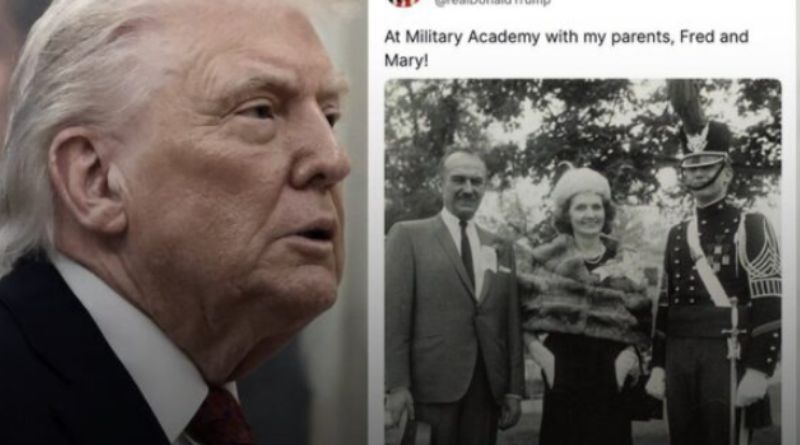
Donald Trump recently drew renewed public attention after sharing a photograph from his teenage years, offering a window into an earlier period of his life that continues to spark reflection and public discussion.
The image shows Trump dressed in a military-style uniform, standing alongside his parents, Fred Trump and Mary Anne MacLeod Trump, during his time at the New York Military Academy. Located in Cornwall-on-Hudson, the academy is known for its structured and disciplined environment, emphasizing leadership, order, and academic rigor—hallmarks of traditional military-style education in the United States. Trump attended the school from the age of 13 through his graduation at 18, a formative stretch that many observers believe helped shape aspects of his personality, including competitiveness, confidence, and an appreciation for hierarchy.
In sharing the photograph, Trump included a brief caption recalling the moment with his parents, framing it as a personal memory rooted in family and youth. On the surface, the post reflects a common human tendency to revisit earlier chapters of life, especially those tied to identity, upbringing, and the influence of family during adolescence.
However, the timing of the post contributed to a broader and more complex public reaction. The image surfaced during a period marked by heightened global tensions, including instability in parts of the Middle East and ongoing discussions surrounding U.S. military activity abroad. In such a climate, even a personal photograph مرتبط with military imagery can take on additional symbolic meaning, influencing how it is received and interpreted by the public.
As a result, the photograph quickly became a focal point for online conversation. Reactions varied widely, shaped by political views, historical awareness, and personal perspectives. Some individuals interpreted the image as a reflection of discipline and structured upbringing, associating Trump’s military academy experience with leadership qualities and personal development. Others, however, connected the post to longstanding public discussions about his past, particularly his record during the Vietnam War.
Born in 1946, Trump reached draft age during a time when the United States relied on the Selective Service System to conscript young men for military service. During that period, he received five deferments—four tied to his education at Fordham University and later the Wharton School at the University of Pennsylvania, and a fifth granted on medical grounds, reportedly due to bone spurs in his heels.
It is important to recognize that both educational deferments and medical exemptions were relatively common during that era, and many individuals used similar legal mechanisms to delay or avoid military service. Nevertheless, such decisions have remained part of public discourse, particularly when viewed alongside the experiences of those who served in combat during the conflict.
Trump has stated in past interviews that he opposed the Vietnam War and that his deferment was based on legitimate medical reasons. Critics, however, have questioned the circumstances surrounding the diagnosis, pointing to broader concerns about access, privilege, and influence. These differing interpretations illustrate the complexity of evaluating historical actions, especially when they are viewed through contemporary standards and expectations.
Following the release of the photograph, social media platforms amplified these contrasting perspectives. Some users expressed support or nostalgia, while others responded with skepticism or criticism. In many instances, the conversation expanded beyond the photograph itself, touching on broader themes such as fairness, civic duty, and individual choice during times of national conflict.
The discussion also extended to Trump’s family, including his son Barron Trump, who has largely remained outside the political spotlight. Some commentators noted that Barron falls within the age range required to register with the Selective Service System, which applies to men between 18 and 25. Although the United States does not currently have an active military draft, registration remains a legal requirement as a precautionary measure.
References to Barron introduced an additional layer to the conversation, raising questions about the boundaries between public interest and private family life. It is not uncommon for relatives of public figures to become subjects of public attention, even when they do not hold official roles or participate directly in political matters. This dynamic can shift the focus of debate away from substantive issues and toward more personal or speculative topics.
At its core, the reaction to the photograph reflects broader themes about how societies remember and interpret history. Military service, particularly during the Vietnam War, continues to hold deep emotional and cultural significance in the United States. For some, it represents duty, sacrifice, and national service; for others, it prompts reflection on policy decisions and the human cost of war.
Trump’s personal history exists within this larger context. His deferments were granted in accordance with the laws and regulations in place at the time, shaping how they are understood from a historical standpoint. At the same time, legal legitimacy does not necessarily resolve ethical questions, which often remain open to interpretation.
The renewed attention sparked by the photograph illustrates how past events can resurface and take on new meaning when viewed through the lens of present circumstances. It also highlights the powerful role of digital media in shaping public discourse, where images can quickly reach large audiences and generate widespread reaction.
In such an environment, nuance can sometimes be lost, as complex issues are reduced to simplified narratives. A more balanced approach involves considering both historical context and individual circumstances, recognizing that multiple perspectives can coexist. This does not require agreement but encourages a more thoughtful and informed exchange of ideas.
Ultimately, the photograph serves as more than a personal snapshot; it acts as a catalyst for broader reflection on leadership, accountability, and historical memory. It demonstrates how a single image can prompt discussion that extends far beyond its original context, encouraging deeper consideration of the past and its ongoing relevance in the present.