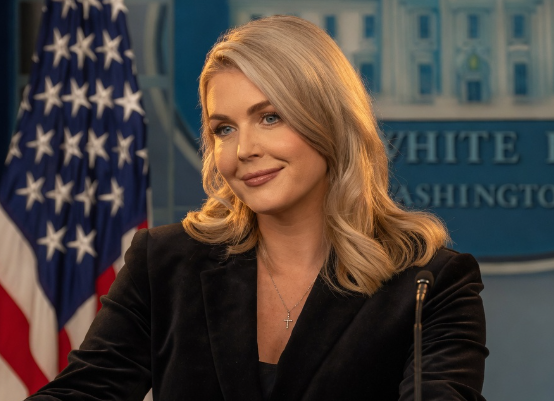
In a high-profile media event hosted by Axios co-founder Mike Allen, White House Press Secretary Karoline Leavitt presented a detailed defense of the Donald Trump administration’s new approach to media relations. Leavitt highlighted a stark contrast between the current president’s commitment to accessibility and what she characterized as the ‘hiding’ behavior of former President Joe Biden. The discussion centered on the administration’s decision to restructure how journalists access the executive branch, moving away from a system that Leavitt argues has long been dominated by a few powerful legacy outlets. By challenging the status quo, the administration aims to ensure that the public receives news through a more diverse and representative group of journalists.
A major point of the dialogue involved the traditional 13-person press pool, which provides close-range coverage of the president. Mike Allen questioned whether new policies might result in ‘history being lost,’ citing the Associated Press and its chief photographer, Evan Vucci, who captured the definitive ‘fight, fight, fight’ image following the assassination attempt in Butler, Pennsylvania. In response, Karoline Leavitt asserted that the administration does not view these changes as ‘restrictions’ but rather as an opening of doors. She argued that it is fundamentally unfair for a small number of outlets to hold a ‘monopoly’ over the briefing room and the pool. By inviting more print and digital outlets—such as Axios—into the rotation, the White House is seeking to foster an environment of greater transparency and accessibility for the thousands of credentialed journalists who cover the beat. The pushback from the White House Correspondents Association (WHCA) was also a central theme. The association has publicly criticized the changes, suggesting that the government should not exercise control over the independent media. Karoline Leavitt countered this by questioning the authority of the WHCA board. She argued that a small group of journalists should not have the power to dictate who is allowed into the Oval Office or who gets to travel on Air Force One. Leavitt insisted that the administration’s goal is to provide ‘equal access for all outlets’ rather than favoring a select few. She further clarified that if the intent were merely to generate positive coverage, they would exclude ‘fake news leftist outlets,’ yet those organizations continue to be granted access under the new, broader policy. This evolution in media strategy is deeply rooted in the ‘nontraditional media campaign’ that defined Donald Trump’s path back to the presidency. Karoline Leavitt explained that in the current digital age, the White House has a responsibility to adapt its coverage to meet the needs of a changing audience. This strategy moves beyond the gatekeeping of traditional wire services and recognizes the influence of a wide variety of news platforms. The administration views this as a necessary modernization of presidential communications, ensuring that the ‘diversity of journalists’ is reflected in the daily reporting of the administration’s activities. This shift is presented not as an ideological move, but as a practical response to the fragmented and rapid nature of modern news consumption. Finally, the discussion touched upon historical data to contextualize the current administration’s efforts. Reference was made to an Axios report titled ‘Biden’s media evasion,’ which pointed out that Joe Biden held significantly fewer press conferences and interviews than any of the last seven presidents at the same point in their terms. While Biden had conducted only 164 such engagements, Donald Trump had already reached 468 during his previous tenure. This comparison, along with figures from the presidencies of George W. Bush and Ronald Reagan, serves as the statistical backdrop for Karoline Leavitt’s argument. By prioritizing frequent engagement and opening the press pool to a wider variety of voices, the Trump administration seeks to reverse what they see as a trend of media avoidance and lack of executive transparency.