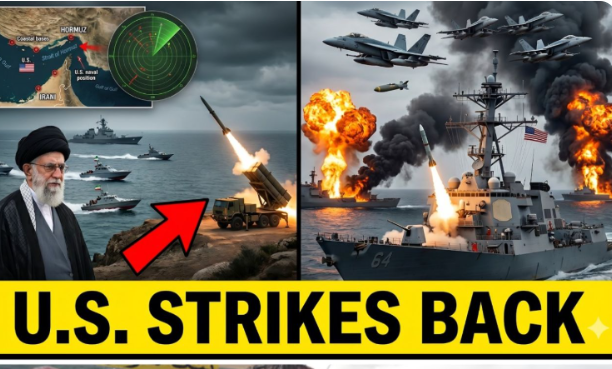
For nearly half a century, the Strait of Hormuz served as the ultimate geopolitical “boogeyman.” This narrow 21-mile ribbon of water, which facilitates the passage of approximately 25% of the world’s seaborne oil, was long branded an “impenetrable killbox” by the Iranian Revolutionary Guard Corps (IRGC). The Iranian strategic doctrine rested on a simple geographical advantage: shore-based missile batteries buried deep within coastal mountain tunnels and massive swarms of fast-attack boats designed to overwhelm any naval intruder. For decades, the international community operated under the assumption that Tehran held a permanent veto over the global energy supply, capable of plunging the world into economic darkness at a moment’s notice.
That paradigm shifted dramatically on February 28, 2026, following the initiation of Operation Epic Fury, a massive coordinated strike against the heart of the Iranian leadership. In a desperate retaliatory move, Iran triggered its “ultimate weapon”—the total closure of the Strait of Hormuz. The immediate impact was felt globally as energy markets entered a severe tailspin. With oil prices surging past $100 per barrel and shipping insurance becoming virtually non-existent, the IRGC began a kinetic campaign, utilizing sea drones and missiles to target tankers. The Iranian command issued a grim promise: any vessel attempting to traverse the corridor would be “set ablaze.”
The United States and its allies did not succumb to the pressure, nor did they rush headlong into the Iranian trap. Instead, the military launched a systematic, layer-by-layer dismantling of the Iranian threat. A critical turning point occurred on March 17, when the U.S. Air Force deployed the GBU-72 Advanced 5K Penetrator in its first combat mission. This state-of-the-art bunker-buster was engineered specifically to reach the “unreachable.” By punching through meters of reinforced concrete and mountain rock, the GBU-72 collapsed the hardened tunnel networks of Iran’s “missile cities.” In a single night of precision bombardment, roughly 90% of the long-range anti-ship missile stockpile along the corridor was neutralized, stripping the IRGC of its primary deterrent.
Once the long-range threat was degraded, the battle moved to the water’s surface to address the infamous “swarm” tactics. The U.S. military employed an unconventional but highly effective duo: the A-10 Thunderbolt II (the “Warthog”) and the AH-64 Apache attack helicopter. The A-10, originally a Cold War tank-hunter, found a second life hunting fiberglass fast-attack craft. Its 30mm rotary cannon turned the Iranian swarm into a graveyard of wreckage. Simultaneously, Apaches patrolled the skies, utilizing clinical precision to pick off one-way attack drones. By the time a tentative ceasefire was reached, the Iranian Navy had been effectively “annihilated,” with over 150 vessels resting at the bottom of the Persian Gulf.
The culmination of this multi-domain pressure was the launch of Project Freedom on May 4, 2026. This was more than a standard naval escort; it was the creation of a sophisticated, multi-layered defensive dome. Protected by ballistic missile-defense destroyers and over 100 land and sea-based aircraft, commercial shipping began to move once more. On April 11, the USS Frank E. Petersen and the USS Michael Murphy provided a masterclass in professional defiance. By switching on their Automatic Identification Systems (AIS) and broadcasting their exact coordinates, they signaled to Tehran and the world that the “killbox” had been cracked. Even during a final, desperate surge of Iranian cruise missiles, the U.S. defensive umbrella performed flawlessly, ensuring no American-protected ships were lost.
Today, the strategic landscape of the Middle East has been fundamentally altered. The missile cities are now dust, the fast-attack boats are gone, and the commanders who orchestrated the blockade have been removed from power. Through the lens of 21st-century warfare, the U.S. Navy has proven that even the most formidable geographical advantages can be overcome by integrated, technology-driven operations. For the millions of people affected by the spike in energy costs and the thousands of mariners who work these waters, the conclusion is clear: freedom of navigation is not a mere suggestion—it is a reality enforced by the most capable fleet in history. The Strait of Hormuz is no longer a weapon for Iran; it is now the ultimate leverage for Washington.