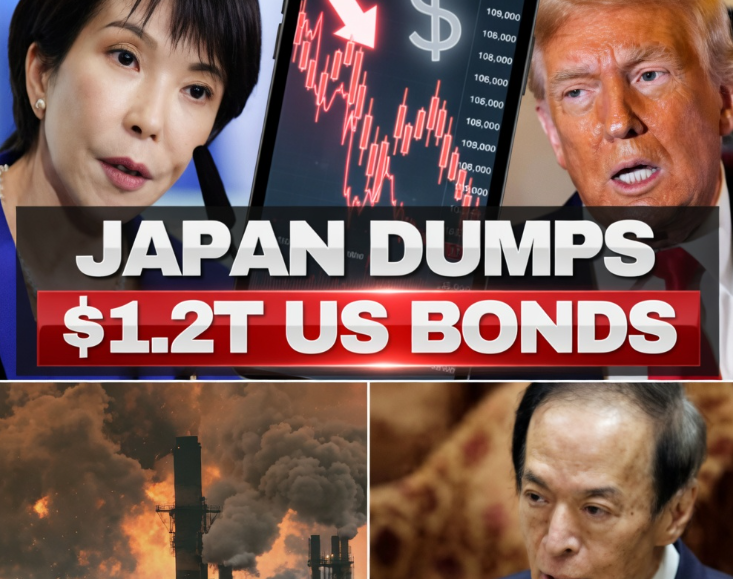
The geopolitical ramifications of the recent United States military engagement in Iran have transitioned from active combat zones to the global financial balance sheets, precipitating what economists describe as a “financial time bomb.” At the center of this looming crisis is Japan, the largest foreign creditor to the United States, currently holding approximately $1.2 trillion in U.S. Treasury bonds. By late March 2026, Tokyo finds itself trapped in a geopolitical vice, forced to decide between maintaining its historical support for American debt or liquidating its holdings to prevent a total domestic economic collapse. This economic volatility is driven by a “double compression” of the Japanese economy. As Brent crude oil prices surge past $113 per barrel—a 50% increase since the conflict began—Japan, a nation almost entirely dependent on energy imports, faces a staggering cost of living crisis. The situation is exacerbated by the Japanese yen weakening toward the critical 160 yen per dollar threshold. In real terms, the currency’s freefall means that $110 oil effectively feels like $140 oil for Japanese consumers. To stabilize the yen, the Ministry of Finance may be compelled to sell off U.S. Treasury holdings to acquire the dollars necessary for market intervention.
Historically, the 160 yen mark has served as the ultimate “line in the sand” for Japan. Unlike other nations, Japan cannot easily raise interest rates to defend its currency due to its massive debt-to-GDP ratio, which is the highest in the developed world. A significant rate hike could result in debt servicing costs consuming 30% of the national budget by 2029. Consequently, selling U.S. debt remains the only viable tool for economic survival. If Tokyo offloads hundreds of billions in bonds, U.S. 10-year Treasury yields could spike beyond 5%, potentially triggering a severe U.S. recession by inflating the costs of mortgages and corporate borrowing. Such a move would represent a watershed moment for dollar hegemony. If Japan—the most loyal security partner of the United States—prioritizes self-preservation over the U.S. debt market, it may break the long-standing taboo against dumping treasuries. Observers in China and the UK are watching closely; a Japanese exit could spark a global liquidation cascade, fundamentally challenging the dollar’s status as the world’s primary reserve currency. Simultaneously, the Federal Reserve faces an impossible choice: raising rates to attract buyers at the risk of a domestic housing crash, or allowing inflation to spiral while the dollar erodes. Further complicating the landscape is the potential unwinding of the “yen carry trade,” valued between $260 billion and $1 trillion. A rapid strengthening of the yen through intervention could force investors to liquidate global assets, potentially wiping out 15-20% of stock market value. Market analysts are now watching for three critical signals: the yen staying above 160 for 48 hours, the Ministry of Finance using “smooth operation” rhetoric, and U.S. 10-year yields hitting the 4.6% Yield Wall. Ultimately, the U.S. may have achieved its military goals in Iran, but the resulting financial strain on its closest ally, Japan, could dismantle the very economic system that sustains American global power.