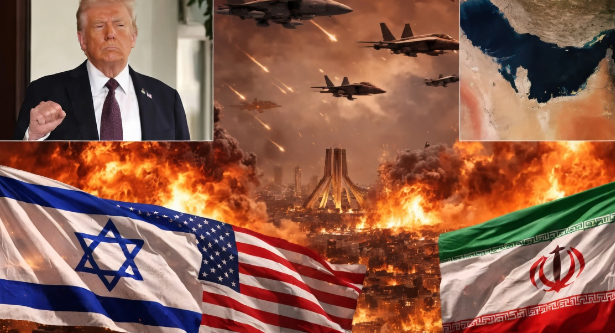
In a geopolitical escalation that has sent shockwaves through the international community, the United States and Israel initiated a massive, coordinated military offensive dubbed Operation Epic Fury. This Saturday morning assault represents one of the most significant military engagements in the Middle East in decades. Targeting the core of the Islamic Revolutionary Guard Corps (IRGC), the strikes focused on high-value military assets including ballistic missile sites, air defense batteries, and critical infrastructure across major Iranian provinces such as Tehran, Isfahan, Qom, Kermanshah, and Karaj. President Donald Trump justified the operation as a defensive measure against “imminent threats” from Iran’s nuclear program, while Prime Minister Benjamin Netanyahu underscored the “existential threat” the regime poses to Israel.
The political stakes of the operation are unparalleled. While reports from Israeli intelligence suggested the potential death of Supreme Leader Ali Khamenei, Iranian state media has vehemently denied these claims, asserting his safety. Beyond the immediate tactical objectives, the rhetoric from the White House indicates a pivot toward regime change, with Trump publicly encouraging the Iranian populace to reclaim their government from decades of theocratic rule. This shift from containment to active destabilization has fundamentally altered the diplomatic landscape of the region, ending any immediate hope for a peaceful resolution to the nuclear standoff.
Iran’s military response was immediate and multi-layered. Within hours of the initial strikes, the IRGC launched significant waves of ballistic missiles and drones. These retaliatory strikes were not limited to Israel but targeted a network of US military installations throughout the Middle East. Strategic locations including Al Udeid in Qatar, Al Dhafra in the UAE, the Fifth Fleet headquarters in Bahrain, and Ali Al Salem in Kuwait reported incoming fire. The broadening of the conflict to include attacks near the capitals of Gulf allies has heightened global concerns of an all-out regional war engulfing the world’s most stable energy producers.
Perhaps the most critical development following the airstrikes is the effective closure of the Strait of Hormuz. The IRGC Navy utilized VHF Channel 16 to broadcast warnings to all commercial shipping, declaring that no vessels are permitted to transit the narrow waterway. Maritime organizations, including the EU’s Operation Aspides and the United Kingdom’s Maritime Trade Operations (UKMTO), confirmed that the Iranian military has labeled the passage “not allowed” and “unsafe.” While a formal, nationwide blockade decree has not been issued by the central government in Tehran—likely to mitigate self-inflicted economic pain—the IRGC’s tactical enforcement has already paralyzed maritime traffic.
The disruption to global energy flows is already evident. Data from Kpler and Bloomberg indicate that numerous oil tankers and LNG carriers have slowed, halted, or begun expensive rerouting maneuvers. Major energy firms and trading houses have suspended transit through the strait, fearing for the safety of their crews and cargo. The US Navy has exacerbated these concerns by issuing advisories stating that it cannot currently guarantee the safety of commercial vessels in the Persian Gulf, leaving the world’s most vital energy artery in a state of high-stakes limbo as owners instruct their fleets to avoid the area entirely.
The strategic importance of the Strait of Hormuz cannot be overstated. As a chokepoint just 21 miles wide, it serves as the transit route for approximately 21 million barrels of oil and refined products daily—roughly 20% of global consumption. For nations like Saudi Arabia, Iraq, Kuwait, the UAE, and Qatar, the strait is the primary exit point for their energy exports. Any prolonged closure would necessitate the rerouting of shipping around the Cape of Good Hope, significantly increasing shipping durations and operational costs. The global economy relies on the steady flow of crude and LNG from this region to maintain industrial stability.
Historically, Iran has used the threat of closing the strait as a geopolitical lever, particularly during the “maximum pressure” campaign of 2019. However, the current situation represents a departure from previous harassment. Despite the degradation of some Iranian naval assets by US strikes, the IRGC maintains substantial asymmetric capabilities. Through the use of fast-attack swarms, naval mines, submarines, and shore-based anti-ship missiles, Tehran can project power across the waterway without traditional naval superiority. The US Fifth Fleet remains on high alert, prepared to forcibly reopen the route if necessary, setting the stage for a potential direct naval confrontation.
Financial markets are bracing for extreme volatility. While markets were closed during the initial strikes, the anticipated resumption of trading on Sunday evening is expected to see a dramatic surge in Brent crude prices. Analysts from Barclays and Rapidan Energy suggest that oil could quickly test the $100 per barrel mark, with worst-case scenarios involving a sustained blockade pushing prices as high as $150. Even a partial reduction in flow would add a substantial “war-risk premium” to every barrel, impacting global inflation indices and consumer confidence.
The ripple effects of an energy crisis would extend into the broader global economy. Asian industrial powers like China, India, Japan, and South Korea are particularly vulnerable due to their heavy reliance on Middle Eastern crude. India’s refining sector is already bracing for cost surges that could stifle economic growth. Furthermore, the skyrocketing cost of LNG spot prices poses a significant threat to energy security in Europe. In the United States, gasoline prices could reach $6 per gallon, fueling domestic inflation and putting immense pressure on manufacturing and transportation sectors.
This conflict does not exist in a vacuum. It follows a pattern of heightened military activity by the United States, including recent operations in Venezuela. The involvement of Iranian proxies, such as the Houthis in Yemen and Hezbollah in Lebanon, adds another layer of complexity. These groups have already threatened to expand the scope of attacks against Israeli and Western interests in the Red Sea and beyond. With diplomatic channels between Washington and Tehran effectively frozen, the risk of miscalculation remains dangerously high as Iran perceives itself to be in a “death ground” scenario.
As of February 28, 2026, the situation remains fluid. While some brave vessels continue to transit the Strait of Hormuz with extreme caution, the psychological and economic impact of the IRGC’s actions has already been realized. The international community now faces a pivotal moment: whether the current tension can be de-escalated through back-channel diplomacy or if it will spiral into a full-scale maritime war that could plunge the global economy into a deep recession. The world watches the Persian Gulf, waiting to see if the rhetoric of Operation Epic Fury leads to an era of unprecedented conflict or a forced restructuring of the Middle East.