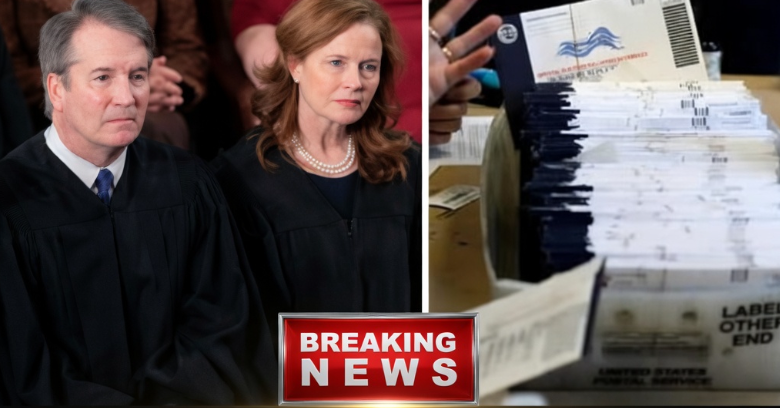
In a significant legal development, the U.S. Supreme Court recently issued an unsigned emergency order to keep New York’s
existing congressional map in place for the upcoming election cycle. This decision effectively halts a lower court’s ruling that had deemed the current boundaries unconstitutional, citing the dilution of voting power among Black and Latino communities. Because the order came through the court’s emergency docket, it did not include a specific vote count or a written justification, a practice typical for such “shadow docket” decisions. This move provides a temporary tactical advantage to Republicans, including figures like Representative Nicole Malliotakis, by ensuring that the current electoral boundaries remain stable as the broader legal appeals process continues. Simultaneously, the high court is preparing to deliver a landmark ruling in the case of Louisiana v. Callais. This dispute centers on a map approved by Louisiana lawmakers that established a second majority-Black district following prior legal challenges. The justices are now tasked with determining whether the use of race to create such districts inherently conflicts with the Equal Protection Clause of the 14th Amendment. This case is pivotal as it directly challenges the application of Section 2 of the Voting Rights Act of 1965, which serves as the primary legal mechanism for private citizens and advocacy groups to contest redistricting plans they believe are discriminatory. The legal framework surrounding these challenges has shifted dramatically since the 2013 Shelby County v. Holder decision, which struck down the federal preclearance requirement. Today, Section 2 remains the last line of defense against gerrymandering that targets minority voting blocs. During recent oral arguments, Chief Justice John Roberts questioned how to align redistricting proposals with the established Thornburg v. Gingles criteria. This test requires plaintiffs to prove that a minority group is sufficiently large, geographically compact, and politically cohesive, while also demonstrating that a majority bloc usually votes as a unit to defeat the minority’s preferred candidates. Meanwhile, Justice Brett Kavanaugh floated the idea of a “sunset” provision, suggesting that race-based legal remedies should not be permanent fixtures of American law. The political ramifications of these rulings are immense. Analysts suggest that the outcome could trigger new redistricting efforts in states like Georgia, South Carolina, Tennessee, Missouri, and Florida. Organizations such as Fair Fight Action and the Black Voters Matter Fund have voiced deep concerns, arguing that a weakened Voting Rights Act could allow partisan legislatures to redraw as many as 19 to 27 congressional seats to favor one party. In response to these federal uncertainties, some state lawmakers are taking matters into their own hands. In Mississippi, legislators Zakiya Summers and Johnny DuPree have introduced bills to establish a state-level version of the Voting Rights Act, seeking to preserve protections for voters within their own borders regardless of the federal court’s eventual trajectory.