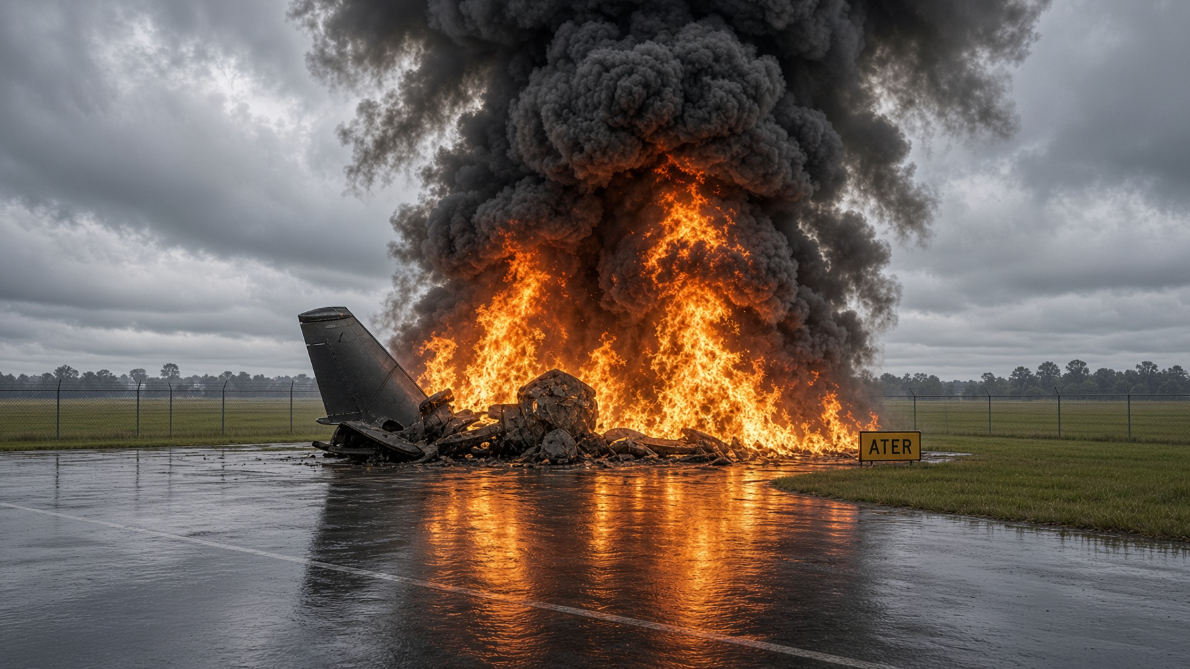
AVIATION DESK — Aviation authorities and regional emergency response agencies are working to verify initial, unconfirmed reports of a catastrophic disaster involving a wide-body passenger airliner reportedly carrying more than 244 passengers and crew.
Crucial operational parameters—including the commercial operating carrier, flight identifier, aircraft registration type, flight origin, intended destination, and precise geographic coordinates—have not been officially released or independently corroborated by civil aviation ministries. International accident monitoring networks emphasize that until sovereign regulators and primary tracking agencies publish authenticated dispatches, accounts surrounding casualties and crash dynamics remain strictly preliminary.
Early alerts indicated that regional air traffic control centers experienced an abrupt loss of primary radar contact and transponder telemetry during an active flight phase. Eyewitnesses within the suspected sector described an aircraft entering a steep descent followed by surface detonations and rising smoke columns. However, with formal incident verification still pending, officials caution against treating early digital sightings and speculative social feeds as conclusive evidence.
In standard emergency response protocols governing potential mass-casualty aviation events, initial units deploy to isolate the sector and secure emergency vehicle access. Search-and-rescue teams, specialized aircraft firefighting squads, and regional trauma networks mobilize along designated staging corridors. Local hospital systems routinely activate mass-casualty contingency procedures, placing intensive-care units, trauma surgical suites, and specialized burn wards on operational alert. Concurrently, airport authorities linked to the affected route establish passenger-assistance reception centers staffed by mental health professionals, family liaison specialists, and consular officers.
Once site safety is confirmed, civil aviation investigators will begin field operations under the protocols of Annex 13 of the International Civil Aviation Organization (ICAO). The objective of such inquiries is strictly technical and preventive: to establish the sequence of events and prevent recurrence, rather than assign legal or criminal liability. The investigation will be spearheaded by the state where the incident occurred, integrated with accredited representatives from the state of design and manufacture, the carrier’s state of registration, and relevant safety boards.
A technical investigation systematically analyzes multiple core disciplines:
-
-
Structural and System Integrity: Airframe wreckage, flight-control surfaces, hydraulic actuators, and power plants are surveyed for signs of in-flight structural separation, catastrophic engine failure, uncontained fractures, or system-wide decompression.
-
Flight Operations and Maintenance: Specialists review dispatch documentation, airframe maintenance records, minimum equipment list (MEL) deferrals, and crew flight-time logs to reconstruct operational history.
-
Atmospheric Data: Radar tracks, meteorological satellite logs, and regional weather stations are analyzed to identify atmospheric threats, including wind shear, severe microbursts, convective storm cells, or structural icing.
-
Traffic Control Transmissions: Communication tapes and transponder telemetry are synchronized to establish a second-by-second reconstruction of flight path, control inputs, and cockpit distress transmissions.
-
Central to resolving the sequence of events is the location and extraction of the aircraft’s crash-survivable memory units: the Flight Data Recorder (FDR) and the Cockpit Voice Recorder (CVR). The FDR logs thousands of time-stamped digital performance parameters—such as pitch, roll, engine thrust, airspeed, and altitude—while the CVR captures cockpit ambient audio, radio transmissions, and audible automated alarms.
Although built to withstand severe impact forces, deep-sea submersion, and extreme post-impact fire, extracting and decoding recorder memory chips requires careful laboratory processing to avoid data corruption. Air safety authorities note that recovering the devices does not yield instant answers; raw hexadecimal files must be calibrated, validated against radar models, and evaluated against physical ground marks.
For international flights, establishing an accurate passenger count requires cross-referencing electronic passenger manifests, gate boarding scans, passport validation data, and transfer passenger lists. Consular channels and carrier representatives operate under strict statutory confidentiality rules, withholding confirmed names until victims are forensically identified and immediate next-of-kin notifications are formally concluded.
While global attention centers on whether anyone survived the initial impact, aviation watchdogs urge restraint. Until accident boards and civil ministries confirm the aircraft identity, complete initial field surveys, and release an authorized preliminary dispatch, the circumstances surrounding the incident remain unconfirmed.