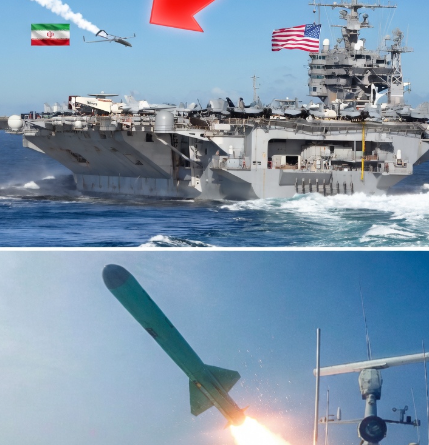
When Iran’s Revolutionary Guard released footage of a drone swarm striking a mockup of the USS Abraham Lincoln, the message was clear: mass-produced, low-cost technology could theoretically overwhelm the most expensive naval assets in the world. This strategy of ‘quantity over quality’ is designed to resonate both domestically in Tehran and internationally among strategic planners monitoring the Strait of Hormuz. However, professional analysis suggests that the cinematic simplicity of propaganda often ignores the staggering technical realities of modern electronic and kinetic warfare. Real-world conflicts are not won by footage, but by the silent interplay of sensors and high-frequency data exchanges.
A real-world engagement would likely begin at long range, far before any drone reached visual distance. The U.S. Navy relies on the E-2D Hawkeye, an airborne early warning aircraft equipped with the AN/APY-9 radar system. This platform identifies low-flying, small-signature targets and feeds that data into the Cooperative Engagement Capability (CEC) network. This allows a Carrier Strike Group to function as a single, distributed sensor net, where a destroyer can fire upon a target using data provided by an aircraft miles away. Such integration renders the ‘saturation’ of a single ship far more difficult, as the defense is managed across a synchronized combat system rather than by isolated platforms. One of the primary challenges identified by naval critics is ‘cost asymmetry’—the necessity of using multi-million dollar interceptors to destroy drones like the Shahed-136, which cost only a few thousand dollars to assemble. To solve this, the Navy is rapidly moving toward directed energy systems, including high-powered microwave weapons and lasers. Unlike traditional missiles, these systems draw power directly from the ship’s generators, effectively shifting the tactical focus from ‘magazine depth’ to ‘power management.’ By disrupting the electronics of incoming swarms rather than relying on physical detonation, these systems threaten to break the economic logic that underpins Iran’s current drone doctrine. Despite the emergence of lasers, traditional layered defenses remain vital. Systems like the Phalanx Close-in Weapon System (CIWS), Rolling Airframe Missiles (RAM), and Standard Missiles (SM-2 or SM-6) provide a protective bubble against more sophisticated threats, such as the Khalij Fars anti-ship ballistic missile. Additionally, MH-60R Seahawk helicopters serve as a critical layer for surface interdiction, neutralizing fast attack boats before they can close the distance. This creates a highly complex ‘choreography’ of automated combat systems, such as Aegis, which perform calculations at speeds no human commander could manage in real time, balancing thermal limits and environmental interference. Ultimately, the most significant consequence of a drone swarm attack may not be the physical damage it inflicts, but the intelligence it inadvertently reveals to the defender. Every drone launch requires the activation of coastal radars, telemetry bursts, and the opening of hidden infrastructure. Surveillance platforms can geolocate these emissions with remarkable precision, mapping an adversary’s entire coastal defense network in the heat of battle. In the final analysis, modern naval power is defined not just by the size of the aircraft carrier, but by the seamless integration of sensors, algorithms, and the quiet evolution of shipboard power systems that counter the loudest of propaganda videos.