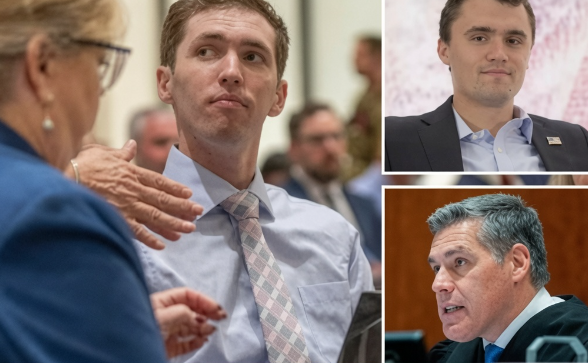
Judge Keeps Death Penalty Option in Tyler Robinson Case
A Utah judge has ruled that Tyler Robinson will remain eligible for the death penalty if he is convicted of aggravated murder in the fatal shooting of Charlie Kirk. The decision came after Robinson’s attorneys argued that prosecutors violated a court-ordered gag rule and asked the court to remove capital punishment as a possible sentence.
Judge Tony Graf Jr. found that Deputy Utah County Attorney Christopher Ballard was in civil contempt for publicly expressing confidence in the overall strength of the evidence against Robinson. The judge determined those remarks improperly conveyed an opinion about Robinson’s guilt. However, Graf rejected the defense’s request to eliminate the death penalty, instead ordering an expanded jury selection process to help ensure a fair trial.
The dispute centered on prosecutors’ public response to defense filings discussing forensic evidence. The defense argued that an ATF firearms analysis could not conclusively match the bullet recovered from the victim to the rifle allegedly linked to Robinson. Prosecutors responded that while the bullet comparison was inconclusive, the caliber matched the suspected weapon and a spent shell casing recovered at the scene was reportedly linked to the firearm.
Robinson is accused of fatally shooting Turning Point USA founder Charlie Kirk during an event at Utah Valley University on Sept. 10, 2025. He has been charged but has not yet entered a plea. A preliminary hearing is scheduled to take place over multiple days in early July.
Meanwhile, prosecutors say they intend to call Robinson’s former roommate, Lance Twiggs, as a key witness. According to court filings, Twiggs received limited use immunity for statements made during a recorded interview with investigators. Prosecutors allege Twiggs told authorities that Robinson admitted to the shooting, concealed the firearm afterward, disposed of clothing connected to the incident, and urged him not to cooperate with law enforcement. Prosecutors also plan to introduce text messages allegedly exchanged between the two.
The defense disputes the prosecution’s account, and the allegations described in court filings have not yet been tested at trial. Judge Graf also recently denied another defense request to delay the proceedings while appealing an earlier ruling allowing cameras in the courtroom.
The case remains in the pretrial stage, with evidentiary issues and witness testimony expected to play a significant role in the upcoming preliminary hearing.